The Quantum Connection: 9 Key Studies Supporting the Reality of Distance Healing

If you said that you could help someone heal from across the Atlantic using nothing but your thoughts and a bit of focused "vibe," I probably would have gently handed you a camomile tea and checked if you’d had enough sleep. As a society, we’re quite comfortable with the idea of a Wi-Fi router sending an email through thin air, yet the moment someone suggests the human brain might have its own "wireless" function, we tend to reach for the nearest tinfoil hat.
But here’s the thing: science—the actual, lab-coat-wearing, peer-reviewed kind—is starting to show up to the party. And it’s not just bringing snacks; it’s bringing evidence. It turns out that the universe might be less like a collection of separate billiard balls bumping into each other and more like a giant, interconnected web where "distance" is just a polite suggestion.
So, grab a cuppa and let’s dive into the data that is currently making traditional physics textbooks look a bit sweaty.
1. The DNA Connection: Emotion as a Catalyst
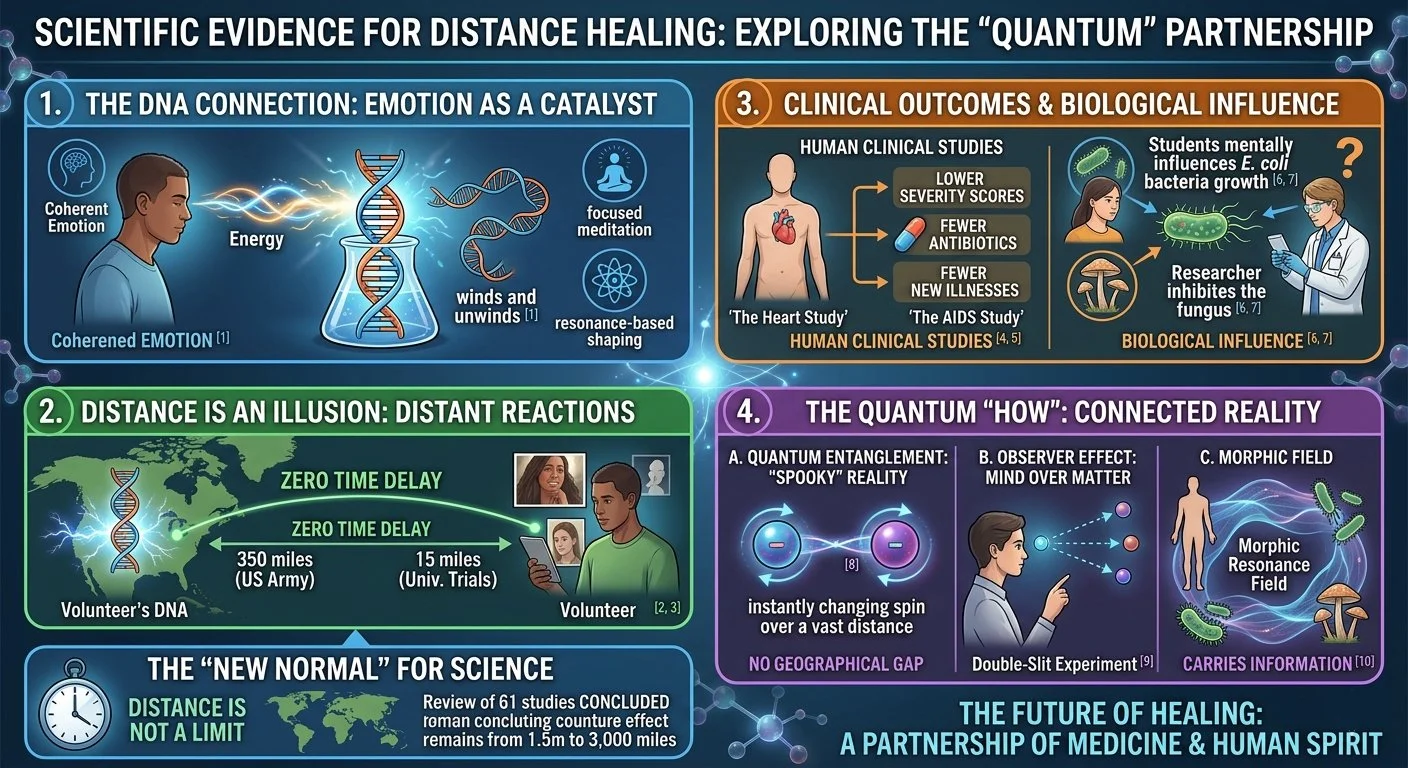
Between 1992 and 1995, the HeartMath Institute conducted a series of trials that would make any biologist do a double-take. They isolated human DNA in a glass beaker and exposed it to "coherent emotion"—a state of focused, positive intention achieved through specific meditation techniques.
The results were remarkable: without physically touching the DNA, participants were able to cause the double helix to either wind or unwind simply by changing their intention. This suggests that our internal emotional state can quite literally "shape" our genetic material. It wasn't a physical intervention; it was a resonance-based one [1].
2. Distance is an Illusion: The US Army & University Trials
A famous US Army study took this a step further, proving that this connection doesn't care about walls or postcodes. They collected a DNA sample from a volunteer and moved it to another room. When the volunteer was shown images that triggered strong emotions, his DNA sample—located elsewhere—reacted instantaneously with a strong electrical discharge. There was zero time delay.
They repeated this experiment at a distance of 350 miles, and the results were identical. Whether in the next room or across the country, the connection remained unbroken [2]. Similarly, researchers at the University of Tennessee successfully replicated experiments on fungus growth from a distance of 15 miles, proving that biological systems respond to intention regardless of geographical gaps [3].
3. Clinical Outcomes: From CCU to Advanced Illness
The impact on human recovery has been documented in high-stakes environments where "placebo" is a hard sell.
The Heart Study: In a double-blind experiment of 393 patients in a Coronary Care Unit, those who were prayed for from a distance had significantly lower "severity scores" during their hospital stay compared to those who weren't. They required fewer antibiotics and less ventilatory support [4].
The AIDS Study: In a 10-week trial involving 40 patients with advanced AIDS, a group receiving distance healing from practitioners across the US (whom they never met) showed fewer new illnesses, fewer hospitalisations, and significantly improved moods compared to the control group [5].
4. The Power of Influence: From Bacteria to Fungus
It isn't just human cells that respond; even the "simpler" life forms seem to be listening. In controlled studies at St. Joseph’s College, students were found to be able to mentally inhibit or promote the growth of E. coli bacteria [6]. Meanwhile, in France, researcher Jean Barry found that people could inhibit the growth of destructive fungus from a distance with a 1-in-1,000 statistical probability that the result was more than just "chance" [7].
The Quantum "How": Why ‘Distance’ is a Relative Term
To understand how this works, we have to stop looking at the world through a magnifying glass and start looking through a quantum microscope. Quantum mechanics has effectively torn up the old rulebook that said things must touch to interact.
A. The "Spooky" Reality of Entanglement
The cornerstone of distance healing’s scientific argument is Quantum Entanglement. Physicists can "entangle" two subatomic particles so they become a single functioning unit. If you change the "spin" of one particle, the other changes instantaneously, even if they are separated by the width of the galaxy. Einstein called it "spooky action at a distance," but today’s physicists call it a fundamental reality [8].
B. The Observer Effect: Mind Over Matter
In the famous Double-Slit Experiment, physicists discovered that subatomic particles behave differently depending on whether or not they are being watched. When observed, "waves of possibility" collapse into solid matter. This suggests that consciousness is not a passive bystander—it is an active participant in creating reality [9]. If "looking" changes an electron, "intending" might just change a cell.
C. The Morphic Field
Biologist Rupert Sheldrake proposes the theory of Morphic Resonance, suggesting there is a field that carries information across space and time [10]. This would explain why the bacteria or fungus responded to human thought. They aren't "hearing" the researcher; they are vibrating within the same field.
The "New Normal" for Science
A review of 61 separate studies on distance healing concluded that distance is not a limit. Whether it is 1.5 metres or 3,000 miles, the effect remains. The effect is universal, measured in humans, animals, plants, and even isolated laboratory cells.
We really are living in an extraordinary time. Our scientific models are finally catching up to what the heart has whispered for millennia: we are far more than just "walking chemistry sets." While the textbooks are being rewritten to include things like epigenetics and quantum bio-fields, I’m just happy to see the clinical world and the energetic world finally shaking hands.
I’ve always said that science is just a little bit late to the party—it’s like the friend who finally arrives at 11:00 PM and says, "Hey, did you guys know energy is a thing?"
Yes, Dave, we knew, but we’re glad you’re here!
The future of healing isn't just about more machines or more pills; it’s about a beautiful, "quantum" partnership between the best of medicine and the boundless power of the human spirit. And honestly? If it means I can send a "healing hug" to a friend in Australia and have a peer-reviewed study to back it up, I’ll take that over a tinfoil hat any day of the week.
Series: Oncology & Healing | Part 1 | Part 2 | Part 3 | Part 4 |
Bibliography & References
Rein, G., and McCraty, R. (1993). Modulation of DNA conformation by heart-focused intention. HeartMath Research Center, Publication No. 93-021. Stable Link
Backster, C. (2003).Primary Perception: Biocommunication with Plants, Living Foods, and Human Cells. White Rose Millennium Press. Official Archive (Refencing the US Army/Backster bio-energy trials).
Nash, C. B. (1982). Test of psychokinetic control of bacterial growth. Journal of the American Society for Psychical Research, 76, 121–125. ASPR Library Archive
Byrd, R. C. (1988). Positive therapeutic effects of intercessory prayer in a coronary care unit population. Southern Medical Journal, 81(7), 826–829. https://doi.org/10.1097/00007611-198807000-00005
Sicher, F., Targ, E., et al. (1998). A randomised double-blind study of the effect of distant healing in a population with advanced AIDS. Western Journal of Medicine, 169(6), 356–363. PMCID: PMC1305403
Solfvin, J. (1984). Mental healing. In S. Krippner (Ed.), Advances in Parapsychological Research, 4 (pp. 31–63). Jefferson, NC: McFarland. Academic Reference
Barry, J. (1968). General and comparative study of the psychokinetic effect on a fungus culture. Journal of Parapsychology, 32, 237–243. Rhine Research Center Archive
Aspect, A., et al. (1982). Experimental test of Bell's inequalities using time-varying analysers. Physical Review Letters, 49(25), 1804–1807. https://doi.org/10.1103/PhysRevLett.49.1804
Radin, D. (2006).Entangled Minds: Extrasensory Experiences in a Quantum Reality. Simon & Schuster. Publisher Link
Sheldrake, R. (2012).The Science Delusion: Freeing the Spirit of Enquiry. Hodder & Stoughton. Official Website/Stable Reference