The Sleep Shift: How to ‘Re-Tune’ Your Energy for Deep Delta Rest
We’ve all been there: staring at the ceiling at 3:17 am, mentally calculating exactly how many hours of life-functioning we have left if we fall asleep right this second. We try the "sleep hygiene" checklist—the blackout curtains are shut tight, the phone is in another postcode, and we’ve drunk enough chamomile tea to float a small boat. Yet, the mind remains a neon sign in a dark alley. We often treat sleep like a mechanical "off" switch, but anyone who has ever woken up feeling like they’ve been "plugged into the mains" knows there is more to the story. Beyond the pillows and the melatonin, there is an invisible, humming dance of energy known as the biofield that decides whether you drift into bliss or spend the night wrestling with your duvet like it’s a heavyweight contender.
What is the Biofield? The Science of the "Hum"
To understand sleep from a biofield perspective, we must move past the idea of the body as just a collection of organs. The biofield is a term recognised by leading global health bodies to describe the massless field that surrounds and permeates living bodies [1].
In clinical terms, every heartbeat and neural firing produces an electromagnetic field. Research into the magnetic field of the heart shows it is approximately 5,000 times stronger than that of the brain. When we talk about the biofield, we are discussing this complex matrix of energy that coordinates our biological functions, acting as a "wireless" communication system for our cells.
The Shift: From Beta "Static" to Delta "Flow"
During our waking hours, the biofield is often in a state of high-frequency "chatter." In the UK, our modern lives are synonymous with Beta brainwave states (12–30 Hz), associated with analytical thinking and, unfortunately, the "fight or flight" response.
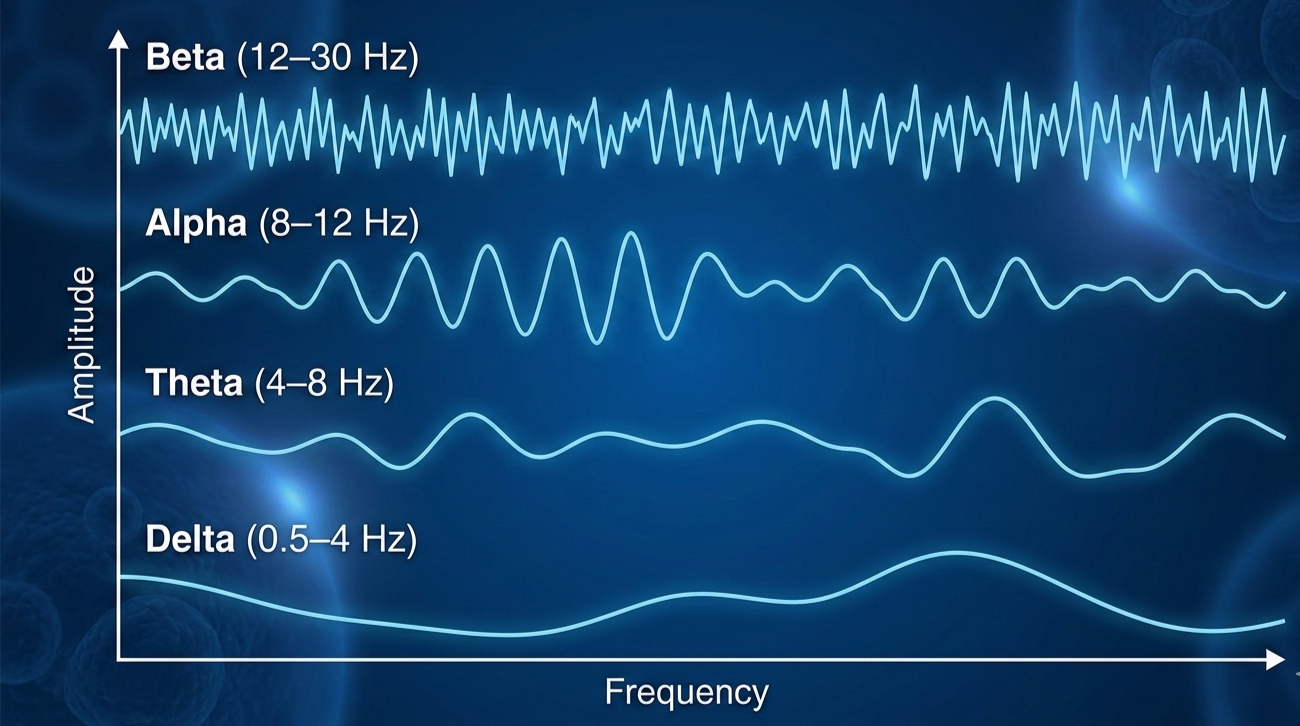
Human Brain Waves
As we transition into sleep, the biofield undergoes a literal frequency shift. Studies on the stages of human sleep suggest that as we relax, the "static" in our field must be cleared for the body to enter the Alpha (8–12 Hz) and eventually the Delta (0.5–4 Hz) states.
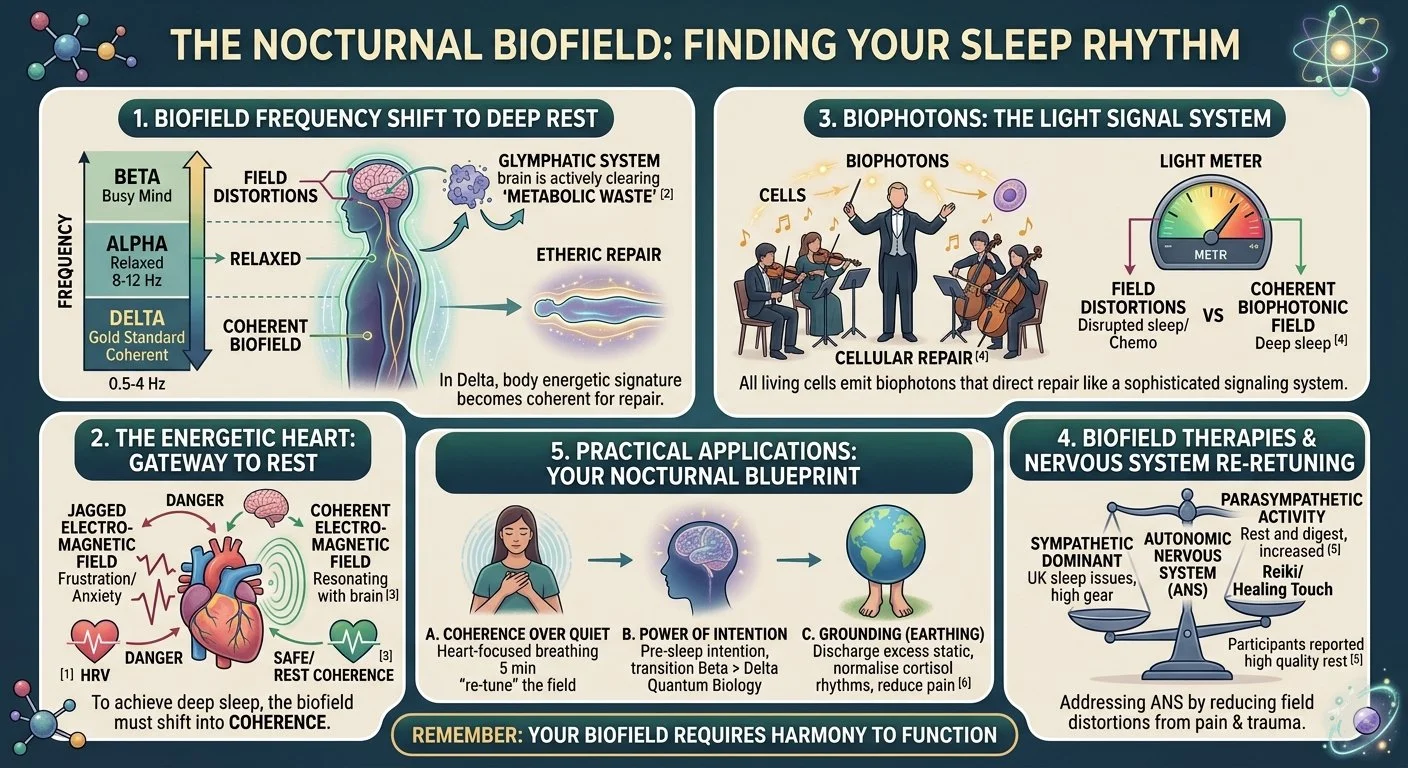
The Delta State: This is the "gold standard" of the nocturnal biofield. In Delta, the body’s energetic signature becomes coherent. Clinical research confirms that during this phase, the glymphatic system is most active, clearing metabolic waste from the brain [2]. From a biofield therapy point of view, this is when the "Etheric body" repairs the "Physical body." If the biofield is too noisy, the glymphatic "cleaning crew" never gets the signal to start work.
The Energetic Heart: The Gateway to Rest
Research conducted by the HeartMath Institute has shown that the heart’s coherence acts as a primary driver for the rest of the body’s systems [3]. The heart produces the largest rhythmic electromagnetic field in the body. If this field is "jagged" due to frustration or anxiety, it sends signals to the brain that the environment is unsafe.
Even if your bedroom is silent, your biofield is screaming "danger." To achieve deep sleep, the biofield must shift into a state of coherence. This isn't just "feeling calm"; it is a measurable physiological state where the heart and brain resonate. Studies on Heart Rate Variability (HRV) and sleep quality demonstrate that high coherence is a prerequisite for reaching the restorative stages of rest. Without it, you stay in "light sleep," perpetually alert.
Biophotons: The Light Within the Dark
One of the more fascinating areas of science supporting biofield theory is the study of biophotons. All living cells emit ultra-weak light particles. The work of Fritz-Albert Popp on biophoton emission demonstrated that these light emissions follow biological rhythms and act as a sophisticated signalling system [4].
During sleep, the pattern of biophoton emission changes. It is theorised that these photons direct cellular repair like a conductor directing an orchestra. When sleep is disrupted—especially during chemotherapy or high-stress periods—the coherence of your biophotonic field is compromised. Biofield therapists argue that insomnia is often a state of energetic incoherence—where the body's internal light-signalling system is out of sync with the Earth's natural cycles.
Biofield Therapies and the Nervous System
Biofield therapy treats sleep issues by addressing the Autonomic Nervous System (ANS). Most sleep disorders in the UK are linked to a "sympathetic dominant" state—the body is stuck in high gear.
Clinical trials on biofield modalities, such as Reiki and Healing Touch, have shown significant increases in parasympathetic activity (the "rest and digest" mode). A study exploring biofield therapy for sleep in cancer survivors found that these treatments significantly improved sleep quality by reducing the "field distortions" caused by physical pain and emotional trauma [5]. Participants didn't just sleep longer; they reported a "higher quality" of rest, waking up feeling truly restored rather than just "less tired."
Practical Applications for your Nocturnal Blueprint
While we will dive deeper into specific therapies later in this series, the foundational science suggests three immediate shifts to help your biofield find its rhythm:
Coherence over Quiet: Don't just focus on a quiet room. Use five minutes of heart-focused breathing to "re-tune" the heart's electromagnetic field before your head hits the pillow.
The Power of Intention: Research in Quantum Biology suggests that intention can influence subatomic particles. Setting a "pre-sleep intention" to clear the day's energy helps the biofield begin its transition from Beta to Delta.
Grounding (Earthing): Since the biofield is electromagnetic, grounding helps discharge excess "positive charge" (static) built up from electronics and Wi-Fi. Studies show that Earthing during sleep normalises cortisol rhythms and reduces pain [6].
An Honest Perspective on Healing
Every individual’s energetic makeup and sleep history is entirely unique. Because of this personal variability, specific results cannot be guaranteed. While many clients report significant improvements in sleep depth and emotional clarity, the way your body integrates and responds to bio-energetic work is specific to you.
Ultimately, biofield therapy serves as a powerful tool for resilience, but it is not a substitute for medical treatment. Instead, it is a sophisticated support system designed to harmonise your energy, ease the emotional trauma of a diagnosis, and create a more receptive internal environment for your body to do what it was designed to do: heal in the dark.
Conclusion: Finding Your Rhythm
Ultimately, understanding your biofield means stopping the war with your pillow. We aren't just meat-machines that need to be "recharged" like an old smartphone; we are vibrant, oscillating fields of energy that require harmony to function.
So, the next time you’re lying there wondering if you can get through tomorrow on three coffees and a prayer, remember that your biofield is likely just trying to find its rhythm. Treat yourself with a bit of "energetic grace." After all, if your biofield has been put through the wringer of a standard British Tuesday—complete with rain, traffic, and someone stealing your favourite mug at work—it’s no wonder it needs a little help finding the "off" switch.
Sleep well, and may your Delta waves be as smooth as a freshly paved road.
Read next In Series: Optimal Sleep | Part 1 | Part 2 | Part 3 | Part 4 | Part 5 | Part 6 |
Bibliography & References
Rubik, B., et al. (2015). The Biofield: Hypothesis and Support from Current Research. Global Advances in Health and Medicine, 4(Suppl), 70–78. https://pmc.ncbi.nlm.nih.gov/articles/PMC4654789/
Xie, L., et al. (2013). Sleep drives metabolite clearance from the adult brain (The Glymphatic Study). Science, 342(6156), 373-377. https://www.science.org/doi/10.1126/science.1241224
McCraty, R., et al. (2009). The Coherent Heart: Heart-Brain Interactions and Psychophysiological Coherence. HeartMath Research Center. Research Archive
Popp, F. A., et al. (2003). Biophoton emission of the human body. Indian Journal of Experimental Biology, 41(5), 440-445. https://www.researchgate.net/publication/8465507_Biophoton_emission_of_human_body
Jain, S., et al. (2012). Biofield Therapies: Helpful or Full of Hype? A Best Evidence Synthesis. International Journal of Behavioral Medicine. https://pubmed.ncbi.nlm.nih.gov/19856109/
Chevalier, G., et al. (2012). Earthing: Health Implications of Reconnecting the Human Body to the Earth's Surface Electrons. Journal of Environmental and Public Health. https://pmc.ncbi.nlm.nih.gov/articles/PMC3265077/