A BIofield Guide to Releasing Anxiety for Restorative Sleep

We’ve all had those nights where our body feels like a lead weight, but our chest feels like it’s hosting a tiny, frantic disco. You’ve done everything right: the lavender oil is misting, your organic cotton pyjamas are on, and you’ve even resisted the urge to check how your primary school rival is doing on LinkedIn. Yet, there’s a distinct "thrum" in your chest—a sort of emotional static that makes the prospect of sleep feel about as likely as a sunny day in Manchester.
In the world of biofield therapy, this isn't just "stress"; it’s emotional congestion in the heart centre. If your heart is still busy processing that passive-aggressive email from your boss or the existential dread of a looming MOT, it simply won't give the rest of your system the "all-clear" to shut down for the night.
The Heart as the Biofield’s Conductor
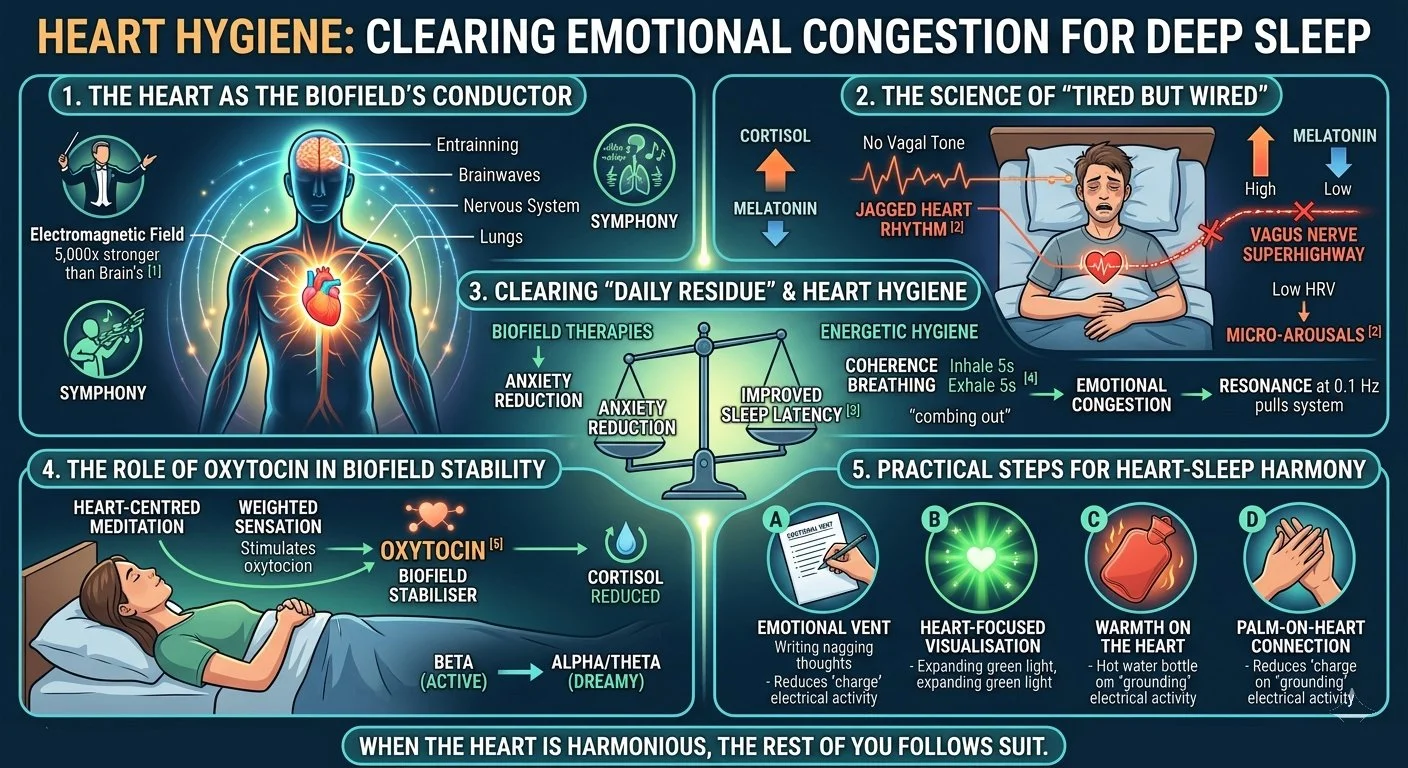
In biofield medicine, the heart is far more than a pump. It is the primary generator of electromagnetic energy in the human body. As we touched on in our first article, the heart’s electrical field is significantly more powerful than the brain's—up to 60 times greater in amplitude, while its magnetic field is approximately 5,000 times stronger [1].
This field acts as a "master conductor," entraining the rhythms of your lungs, nervous system, and brainwaves into a single, cohesive symphony. However, the heart centre is also the primary processing hub for our emotions. When we experience "emotional congestion"—unprocessed grief, anxiety, or even over-excitement—the electromagnetic rhythm of the heart becomes disordered.
This state of "incoherence" keeps the sympathetic nervous system (our "fight or flight" mode) active, effectively locking the door to deep sleep.
The Science of "Tired but Wired"
If you’ve ever felt exhausted but unable to switch off, you are likely experiencing a lack of vagal tone. The vagus nerve is the "superhighway" of the parasympathetic nervous system, and it is intimately connected to the heart.
Clinical research into Heart Rate Variability (HRV) and sleep shows that a "jagged" heart rhythm is directly correlated with poor sleep architecture [2]. When the heart centre is congested with the day's residue, it fails to signal the vagus nerve to initiate the "rest and digest" sequence. Instead, the body remains in a state of high alert, producing cortisol when it should be producing melatonin. A 2023 study confirmed that patients with low HRV scores—indicating high emotional stress—experienced significantly more "micro-arousals" during the night, preventing them from reaching deep Delta-wave sleep.
Clearing the "Daily Residue"
A study published in the Journal of Evidence-Based Integrative Medicine suggests that biofield therapies can significantly reduce anxiety levels, which in turn improves sleep latency—the time it takes to actually fall asleep [3]. You don't always need a practitioner, though; you can perform "energetic hygiene" on your own heart centre by using Coherence Breathing.
This involves breathing at a specific rhythm of five or six seconds per inhale and exhale. Research published by the NCBI shows that this rhythm synchronises the heart and brain, effectively "combing out" the static in your biofield [4]. By breathing at 0.1 Hz, you pull your entire nervous system into a state of resonance, which clears the emotional congestion that acts as a barrier to rest.
The Role of Oxytocin in Biofield Stability
When we focus on the heart, we stimulate the production of oxytocin, often called the "cuddle hormone." In the biofield, oxytocin acts as a stabiliser. Research indicates that oxytocin levels are intrinsically linked to sleep regulation and the reduction of cortisol [5].
By performing heart-centred meditations or even using a "weighted" sensation over the chest (like a hot water bottle or a heavy duvet), we encourage the heart’s field to expand and soften. This "softening" is the energetic signal the brain needs to transition from the active Beta state into the dreamy Alpha and Theta states.
Practical Steps for Heart-Sleep Harmony
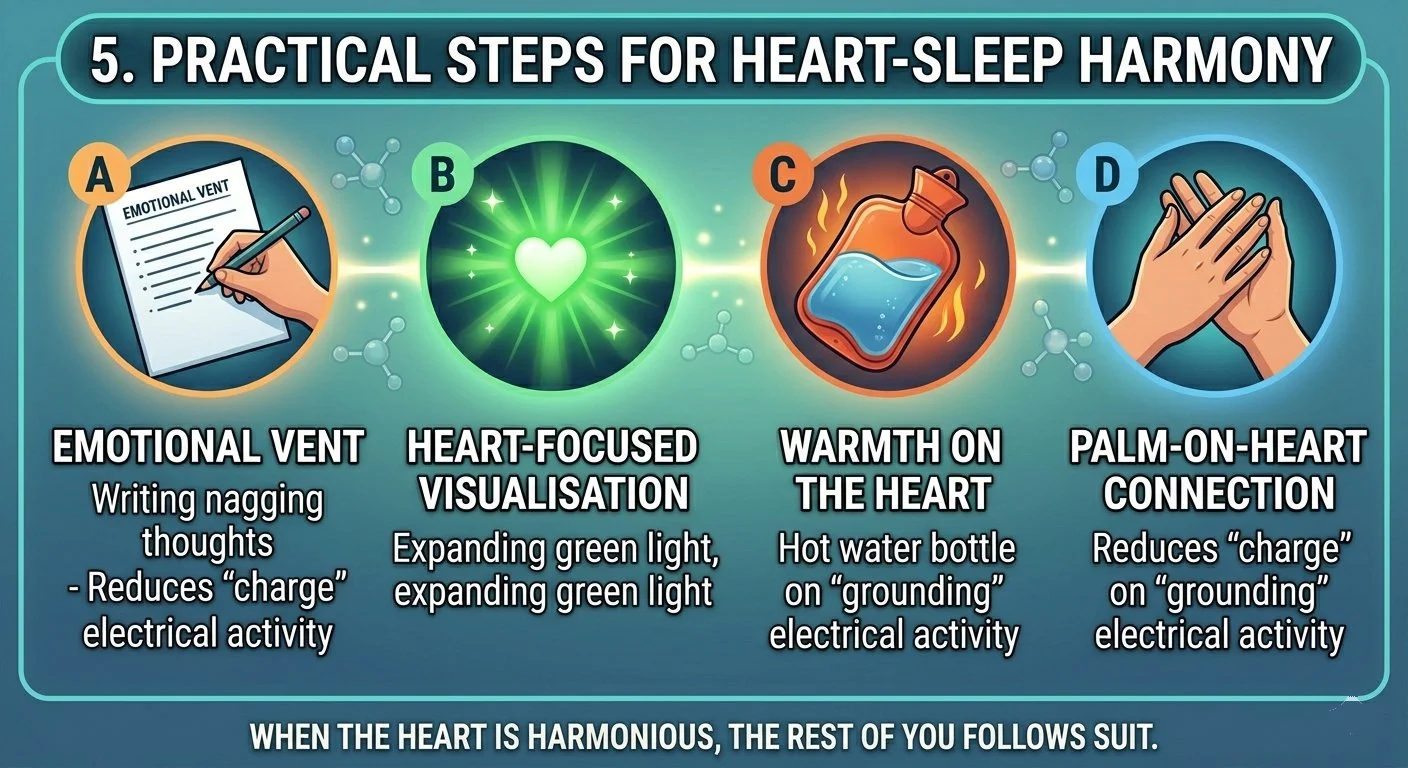
To clear your heart centre before bed, consider these biofield-friendly habits:
The "Emotional Vent": Spend three minutes writing down every nagging thought from the day. This isn't a diary entry; it’s an "evacuation." By moving the information from your internal field onto paper, you reduce the "charge" in the heart centre.
Heart-Focused Visualisation: As you lie in bed, imagine a soft, emerald-green light expanding from the centre of your chest with every breath. Visualise this light dissolving the "grey" static of the day's stress.
Warmth On The Heart: If visualising isn’t your thing, grab a hot water bottle (not too hot) and place it on your chest for ten minutes. The conductive heat helps to "ground" the heart’s electrical activity.
The Palm-on-Heart Connection: Simply placing your right hand over your heart centre can trigger a calming biofield response. The heat and intentional connection help to "ground" the heart’s electrical activity.
Why "Heart Hygiene" is Your New Best Friend
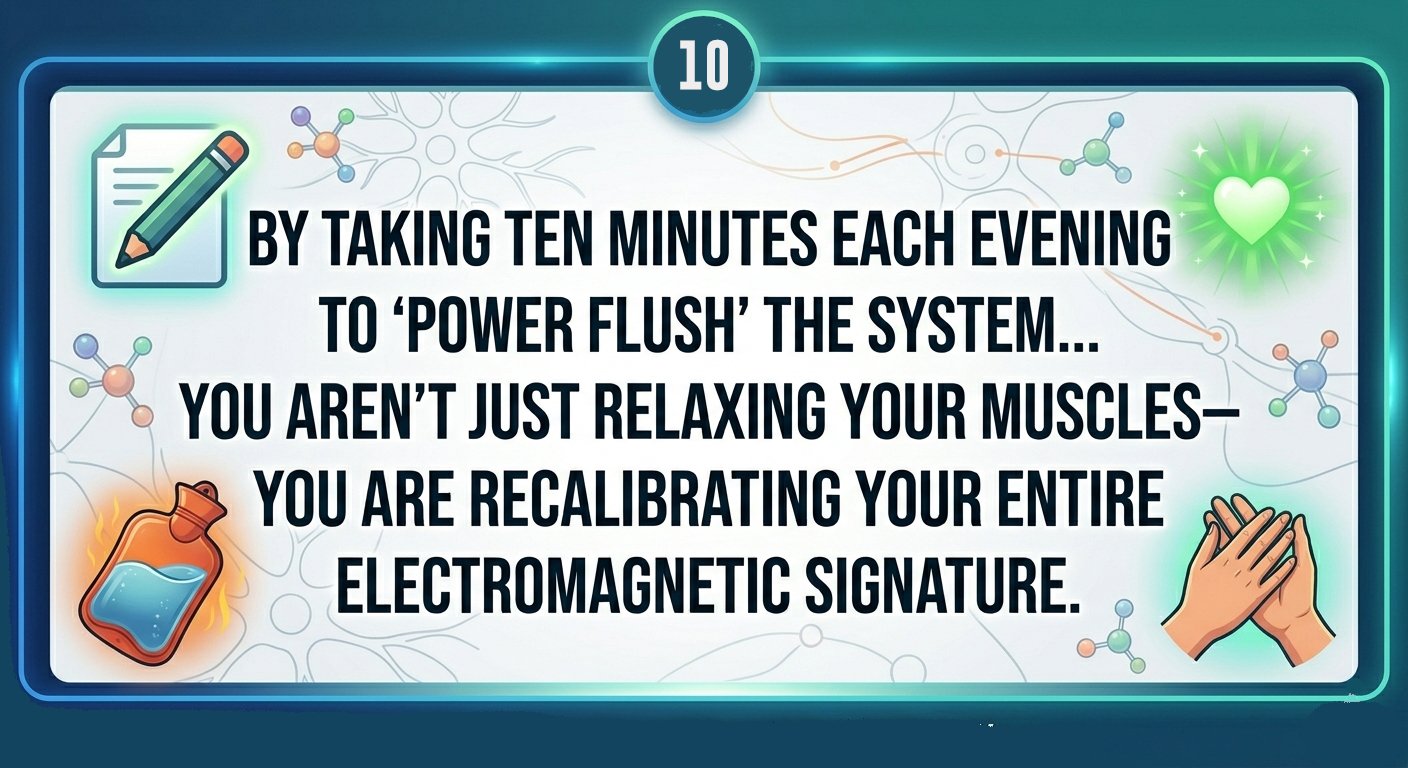
Think of your heart centre as the radiator of your energetic home. If the pipes are clogged with the "sludge" of daily life, the whole house stays cold and uncomfortable. By taking ten minutes each evening to "power flush" the system through breathing, intention, or biofield work, you aren't just relaxing your muscles—you are recalibrating your entire electromagnetic signature.
So, the next time you find yourself ruminating over whether you sounded "a bit weird" in that meeting six hours ago, give your poor heart a break. It’s been doing its best to keep your biofield afloat all day, and it deserves a bit of a polish. Put the phone down, place a hand on your chest, and breathe some space into that disco-dancing heart of yours.
You’ll find that when the heart is harmonious, the rest of you follows suit, drifting off into a sleep so deep that even the neighbour's early-morning car alarm won't stand a chance. Sleep well, and may your heart be as light as a feather by the time your head hits the pillow.
Read Next In Series: Optimal Sleep | Part 1 | Part 2 | Part 3 | Part 4 | Part 5 | Part 6 |
Scientific References & Further Reading
HeartMath Institute.Science of the Heart: Heart-Brain Communication.Official Publication
Ju Ah Kim,, et al. (2017). Relationship among Sleep Quality, Heart Rate Variability, Fatigue, Depression, and Anxiety in Adults. https://kjan.or.kr/journal/view.php?number=1323
Jain, S., et al. (2015). Biofield Therapies and Anxiety: A Clinical Review. SAGE Journals. https://pmc.ncbi.nlm.nih.gov/articles/PMC4654788/
Zaccaro, A., et al. (2018). How Breath-Control Can Change Your Life: A Systematic Review on Psycho-Physiological Correlates of Slow Breathing. Frontiers in Human Neuroscience. https://pmc.ncbi.nlm.nih.gov/articles/PMC6137615/
Shari Young Kuchenbecker,et al. (2020). Oxytocin, cortisol, and cognitive control during acute and naturalistic stress. Nature: Scientific Reports. https://doi.org/10.1080/10253890.2021.1876658