The Clinical Evidence: Energy Healing in Oncology
I know, I know—receiving healing through the 'ether' while you’re tucked up in your pyjamas sounds a bit like magic, but even the scientists in lab coats are starting to nod their heads at this one. For years, the conversation around Reiki was tucked away in the "spirituality" corner of the library. Today, however, it has moved firmly into the "Clinical Data" section. We are finally seeing the "why" and the "how" behind what many patients have known instinctively for decades: that energy work is a vital, measurable component of a modern recovery plan.
A Summary of Research and Patient Outcomes
In the field of integrative medicine, "biofield therapies" like Reiki and bio-energetic healing are no longer seen as purely spiritual practices. They are being rigorously studied in clinical settings for their ability to support the human system during the most demanding phases of cancer treatment. Below is a summary of key clinical studies and meta-analyses demonstrating the measurable impact of these therapies on patient well-being.
1. Managing Chemotherapy Side Effects in Real-Time
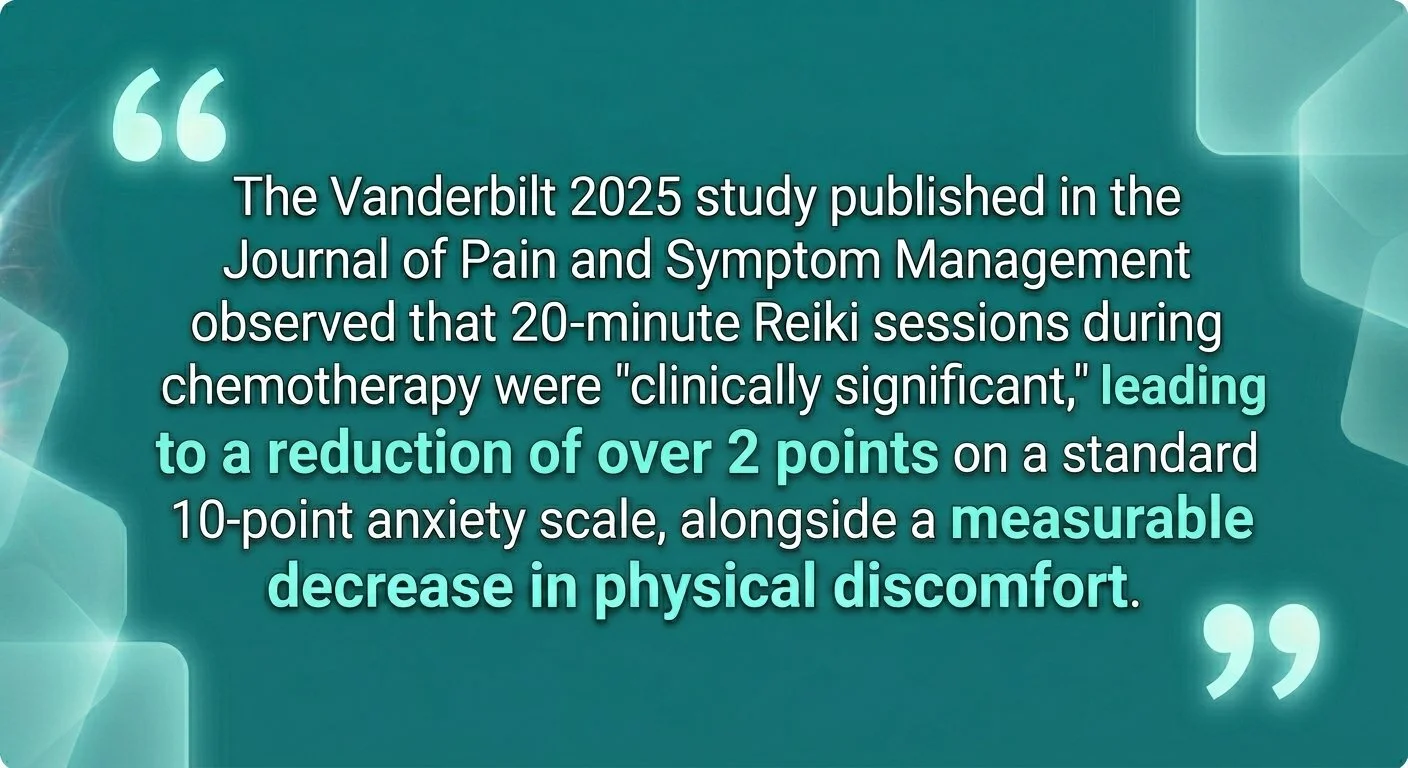
One of the most significant hurdles in oncology is the immediate physical distress of the infusion chair. A landmark study titled Evaluation of a Reiki Volunteer Program within Two Cancer Infusion Centres, published in the Journal of Pain and Symptom Management (March 2025), provided a pragmatic look at this exact scenario [1].
This large-scale study involved 268 unique patients receiving chemotherapy infusions. While the medicine dripped, participants received 20-minute Reiki sessions. The findings were "clinically significant"—a term doctors use when a result is strong enough to change how they treat patients.
Anxiety: Patients reported a reduction of over 2 points on a standard 10-point scale.
Pain & Nausea: There was a measurable decrease in physical discomfort and the "sickness" response often triggered by chemotherapy drugs.
Resilience: Perhaps most importantly, there was a significant increase in the patients' overall sense of peace.
This confirms that Reiki isn't just a "nice to have" after-care; it is a viable, effective tool for outpatients actively undergoing treatment.
2. Addressing the "Wall" of Cancer-Related Fatigue (CRF)
Patients often describe fatigue as the most debilitating side effect of the journey—a "bone-deep" exhaustion that a night’s sleep simply cannot fix. A pilot crossover trial, frequently cited in Integrative Cancer Therapies, compared the effects of Reiki sessions directly against periods of simple rest [2].
The results challenged our traditional understanding of recovery. While "resting" provided a temporary pause, it didn't change the body's baseline energy. However, the Reiki group experienced significant decreases in both tiredness and anxiety.
The long-term impact was even more striking. Using the FACT-G scale (a validated tool for measuring quality of life in cancer patients), researchers found that the improvements from Reiki were sustained over time. It suggests that energy work helps the body "recharge" its internal battery rather than just pausing the drain.
3. The "NK Cell" Discovery: Preserving the Immune System
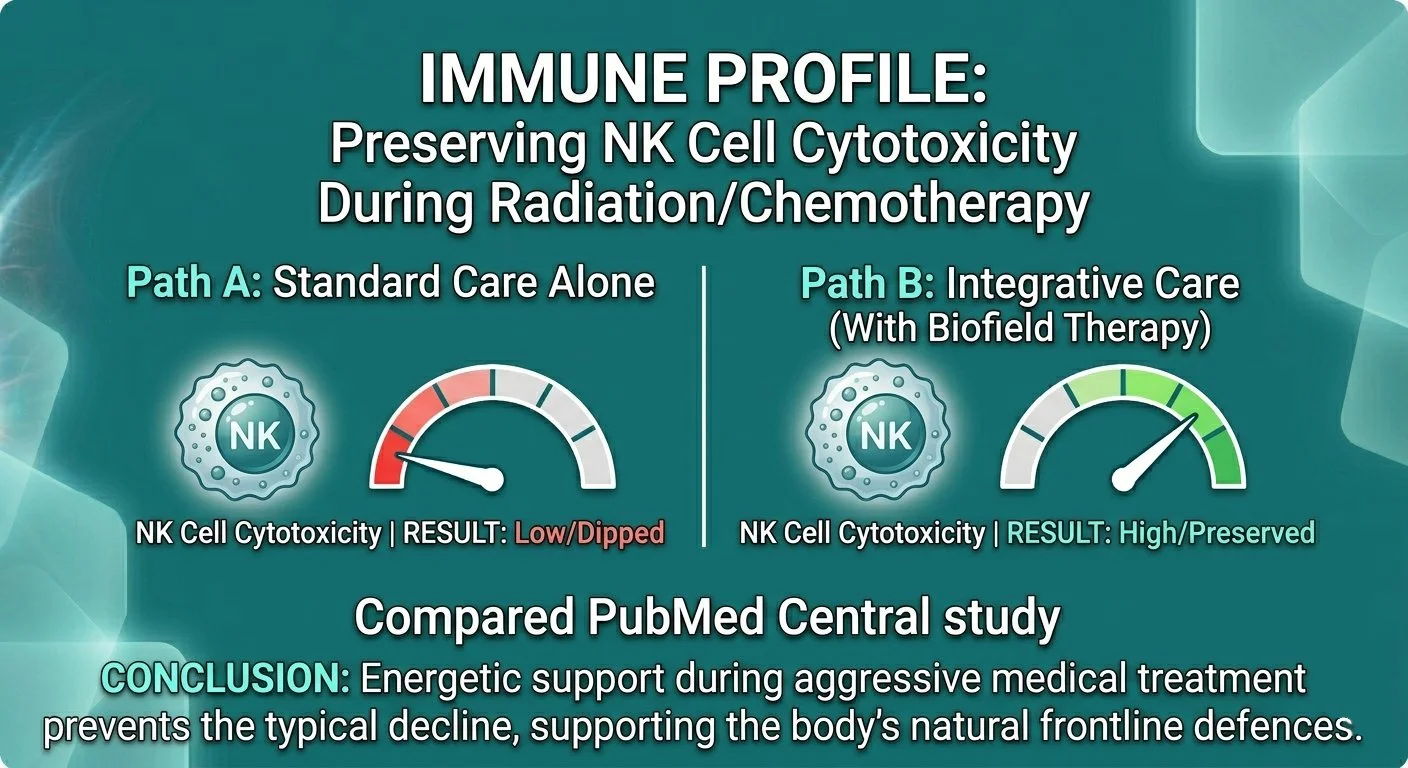
Perhaps the most "hard-science" evidence comes from the study of the immune response during radiation. A study titled The Use of Healing Touch in Integrative Oncology, documented via PubMed Central, looked at the behaviour of Natural Killer (NK) cells—the body’s frontline defence against malignancy [3].
Under standard radiation and chemotherapy, a patient's NK cell cytotoxicity (their "fighting power") usually declines sharply. However, this study found that patients receiving biofield therapy maintained their NK cell activity levels despite the aggressive nature of their medical treatment.
While the standard care group saw their immune function dip, the energetic support group showed a "preserved" immune profile. This suggests that bio-energetics might act as a protective "buffer," helping the body’s natural defences stay online while the medical team does their work.
4. Quality of Life: The 2025 Meta-Analysis
In early 2025, a systematic review and meta-analysis were registered with PROSPERO, analysing data from 661 participants across various cancer types and stages [4]. This study was designed to answer one question: Is the benefit of energy healing consistent?
The analysis confirmed a significant, universal enhancement in overall Quality of Life (QoL). Interestingly, the researchers noted a "dosage effect." While even a single 20-minute session provided acute relief for anxiety, a consistent, multi-week programme provided the most robust improvements in physical mobility and self-care capacity. This mirrors the findings of a 2017 review which concluded that Reiki is consistently better than a placebo for inducing the "parasympathetic" state necessary for healing [5].
5. Managing the "Distress" of Radiation
Radiation therapy often carries a heavy psychological burden, alongside physical skin sensitivity and internal inflammation. A 2012 study published in the European Journal of Integrative Medicine observed patients in a day oncology unit and found that those receiving energy work reported significantly lower levels of "distress" compared to those receiving standard care alone [6].
By lowering the body’s "cortisol ceiling," bio-energetic work allows the patient to remain in a state of physiological calm. This is vital because a body in "survival mode" (high cortisol) is biologically less efficient at repairing the healthy tissue damaged during radiation cycles.
Integrating This Into Your Care
We are finally moving past "seeing is believing" and into a time where the clinical world recognises the body as a vibrant symphony—one that sometimes just needs help finding its tune. It’s an exciting frontier where hospitals and healing spaces work hand-in-hand.
Whether it is preserving immune function [3], reducing the pain of infusion [1], or recharging the "battery" of a fatigued system [2], the data is clear: energy work is a sophisticated, evidence-based support system.
Science might be taking the scenic route to get here, but the destination is beautiful. We are moving toward a truly "integrative" future where we don't just treat the disease, but we support the whole person. Here’s to the future of medicine: a bit more heart, a lot more energy, and a whole lot of hope.
Read Next In Series: Oncology & Healing | Part 2 |
Bibliography & References
Vanderbilt, S., et al. (2025). Evaluation of a Reiki Volunteer Program within Two Cancer Infusion Centres. Journal of Pain and Symptom Management, 69(3). https://pubmed.ncbi.nlm.nih.gov/39613272/
Tsang, K. L., et al. (2007). Pilot crossover trial of Reiki versus rest for treating cancer-related fatigue. Integrative Cancer Therapies, 6(1), 25-35. https://pubmed.ncbi.nlm.nih.gov/17351024/
Lutgendorf, S. K., et al. (2010). Preservation of immune function in cervical cancer patients during chemoradiation using a biofield therapy. Brain, Behavior, and Immunity, 24(7), 1231-40. https://pubmed.ncbi.nlm.nih.gov/20600809/
PROSPERO (2025). Effects of Reiki Therapy on Quality of Life: A Meta-Analysis of Randomised Controlled Trials. National Institute for Health Research (NIHR). https://pmc.ncbi.nlm.nih.gov/articles/PMC11951753/
McManus, E. (2017). Reiki Is Better Than Placebo and Has Broad Potential as a Complementary Health Therapy. JEBCA, 22(4), 1051–1057. https://pmc.ncbi.nlm.nih.gov/articles/PMC5871310/
Birocco, N., et al. (2012). The effects of Reiki therapy on pain and anxiety in patients attending a day oncology unit. European Journal of Integrative Medicine, 4(3), e249-e254. https://pubmed.ncbi.nlm.nih.gov/21998438/