Hack Your Brainwaves: How Binaural Beats Act as a ‘Digital Sedative’ for the Modern Mind

We’ve all been there: you’ve survived a day of back-to-back Zoom calls, navigated the local supermarket like it was a combat zone, and finally crawled into bed. You’re exhausted, but your brain is still "pinging" like a microwave that won't stop beeping.
When you’re at that level of "done," asking your brain to meditate is like asking a caffeinated squirrel to sit still and contemplate the void. It is just not going to happen. This is where auditory entrainment—specifically Binaural Beats—becomes an essential modern tool. Think of it as a "digital sedative" for the 21st century. By using sound to guide the brain into Delta frequencies, we can effectively "tether" the biofield to a state of deep, restorative rest, bypassing the restless ego entirely. It is the ultimate lazy person’s guide to a biological reset.
The Physics of Entrainment: Tuning Your Internal Radio
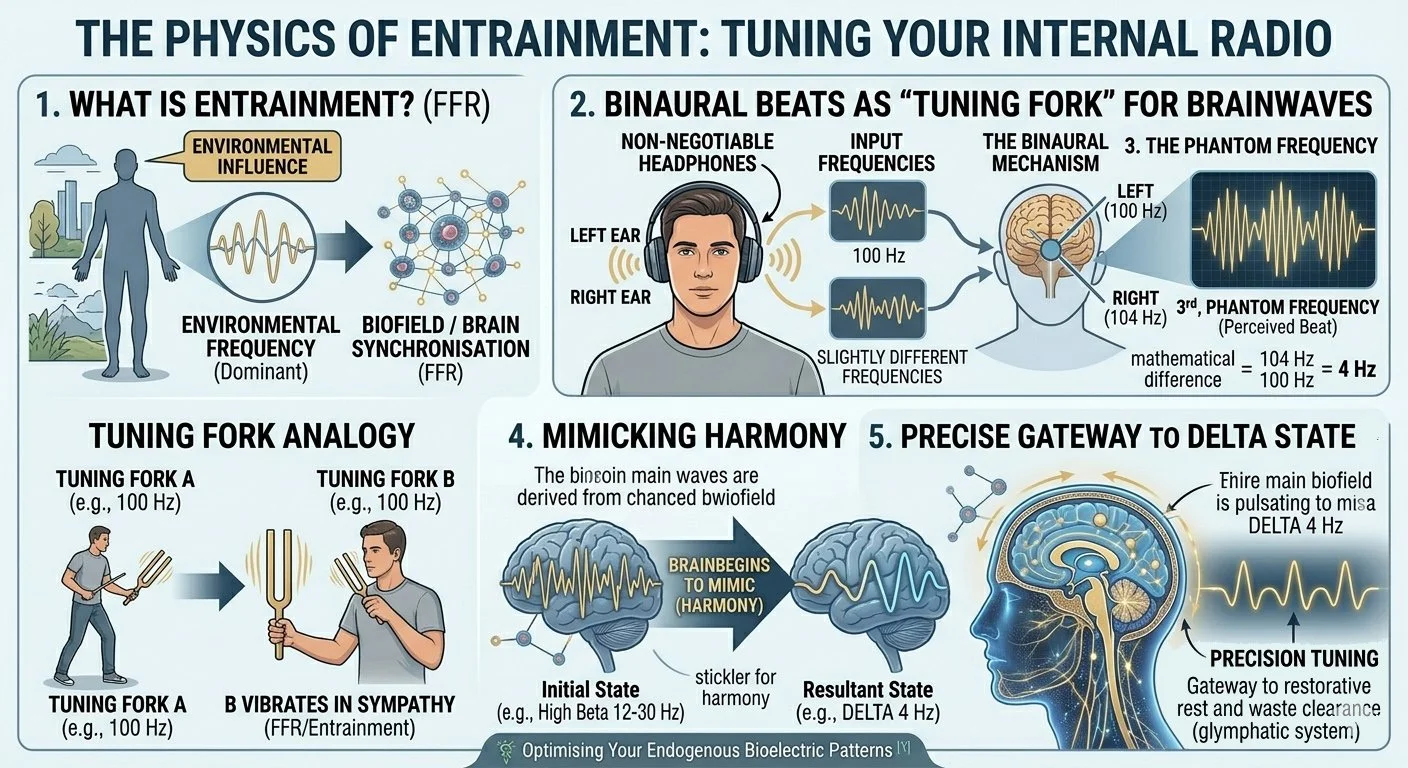
To understand binaural beats, we must first understand the Frequency Following Response (FFR). Our brains and our biofields are naturally "gregarious"—they like to synchronise with the dominant frequency of their environment. If you strike a tuning fork and hold it near another of the same frequency, the second one will begin to vibrate in sympathy. This is entrainment.
Binaural beats take advantage of this physical law to act as an external "tuning fork" for your grey matter. When you play a slightly different frequency into each ear (this is why headphones are a non-negotiable requirement), the brain "hears" a third, phantom frequency—the mathematical difference between the two. If the left ear hears 100 Hz and the right ear hears 104 Hz, the brain creates a perceived beat of 4 Hz. Because your brain is a stickler for harmony, it begins to mimic that 4 Hz rhythm. This 4 Hz frequency is the precise gateway to the Delta state [4].
Mimicking the Delta Wave: The Blueprint’s Repair Zone
As we’ve established throughout this series, the Delta state (0.5 to 4 Hz) is the "Golden Zone" for the biofield. This is the frequency of deep, dreamless sleep where the body stops worrying about the "to-do" list and starts performing critical maintenance. From a biophysical perspective, Delta waves facilitate:
Hormonal Regulation: The release of growth hormone for physical tissue repair [2].
Glymphatic Clearance: The "washing" of metabolic waste from the brain—essentially a nightly rinse for your neurons.
Biofield Restructuring: The smoothing out of the "jagged" energetic patterns created by daily stress and EMF exposure.
By using binaural beats to mimic these Delta waves, we aren't just "relaxing" the mind; we are providing an external scaffolding for the biofield. We are giving the Bioelectric Blueprint a steady, coherent rhythm to latch onto, allowing it to settle into its repair cycle even when the environment is noisy or the mind is anxious [1].
The Protocol: How to Use the Digital Sedative
To effectively "rinse" your brain, you need more than just a random YouTube track. You need a deliberate approach to acoustic hygiene.
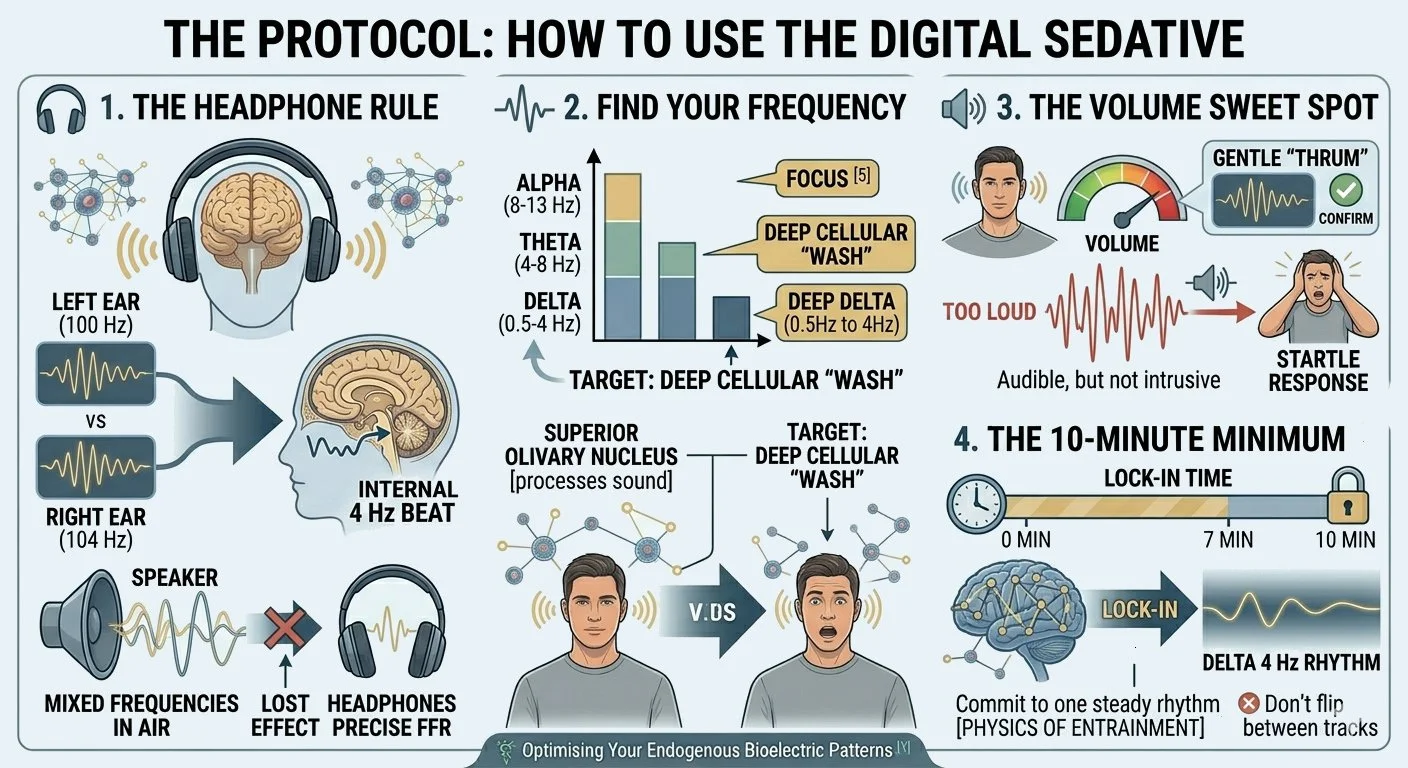
The Headphone Rule: Because the "beat" is created inside your superior olivary nucleus (the part of the brain that processes sound), the two frequencies must be kept separate until they reach your brain. If you play them through speakers, the frequencies mix in the air and the effect is lost.
Find Your Frequency: Look for tracks specifically labelled "Deep Delta" or "0.5Hz to 4Hz." Anything higher (like Theta or Alpha) is great for focus [5], but it won’t trigger the deep cellular "wash" that Delta provides.
The Volume Sweet Spot: More volume does not mean more healing. In fact, if the sound is too loud, it can trigger a "startle" response. The sound should be a gentle "thrum" in the background—audible, but not intrusive.
The 10-Minute Minimum: It takes the brain roughly 7 to 10 minutes to "lock in" to an external frequency [3]. Don't flip between tracks. Commit to one steady rhythm and let the physics of entrainment do the heavy lifting.
Beyond the Ears: The Biofield Impact
When your brainwaves sync to these Delta frequencies, it creates a ripple effect across your entire system. This is known as Systemic Coherence. Studies show that auditory entrainment can significantly lower cortisol (the stress hormone) and improve Heart Rate Variability (HRV) [1]. When your HRV is high and your cortisol is low, your Bioelectric Blueprint becomes more resilient. You are no longer a "frayed wire" reacting to every digital spark; you become a grounded, coherent field of energy that can withstand the "tech-smog" of the modern world.
Conclusion: Stop Fighting, Start Syncing
We spend so much of our lives trying to force ourselves to feel better—forcing ourselves to calm down, forcing ourselves to sleep, or forcing ourselves to be "mindful" when we actually just want to throw our laptop out the window. But sometimes, the most "Stoic" thing you can do is admit that your brain needs a bit of mechanical assistance.
Tonight, instead of lying there debating with your inner critic about that awkward thing you said in 2014, just change the channel. Put on your headphones, find that 2Hz thrum, and let the acoustic tuning fork pull you back into alignment. You aren't just listening to music; you are giving your blueprint the quiet it needs to rebuild itself. Let the frequency do the hard work while you do the very important job of doing absolutely nothing. Sleep well, you beautiful, vibrating field of energy.
Scientific References & Bibliography
Garcia-Argibay, M., et al. (2019).Efficacy of binaural auditory beats in cognition, anxiety, and pain perception. Psychological Research. View Study
Abeln, V., et al. (2014).Brainwave entrainment for better sleep and post-sleep state of athletes. European Journal of Sport Science. View Research
Jirakittayakorn, N. & Yumuang, S. (2017).Brain Responses to 40-Hz Binaural Beat and Effects on Working Memory. Frontiers in Psychiatry. View Study
Chaieb, L., et al. (2015).Auditory Beat Stimulation and its Effects on Consciousness and Etiology. Frontiers in Human Neuroscience. View Research
Lane, J. D., et al. (1998).Binaural Auditory Beats Affect Vigilance Performance and Mood. Physiology & Behavior. View Study