The Student Brain Hack: Double Your Focus and Bulletproof Your Memory

Let’s be real: your concentration span is currently under siege. Between the constant pings of your phone and the soul-crushing weight of a 2,000-word essay, your brain is likely operating at about 20% of its actual potential. If you’ve ever sat at your desk for four hours and only actually "learned" for twenty minutes, this article is your manual override.
In the next three minutes, I’m going to give you the exact biophysical "cheat codes" to bypass burnout. We are talking about Gamma 40 Hz to turn your focus into a laser, Yoga Nidra to "save" your data while you nap, and a 15-minute morning hack to ensure you don't blank out in the exam hall. This isn't "study harder" advice; it’s a high-performance system upgrade for your grey matter.
1. The Study Phase: Gamma as "Genius Glue"
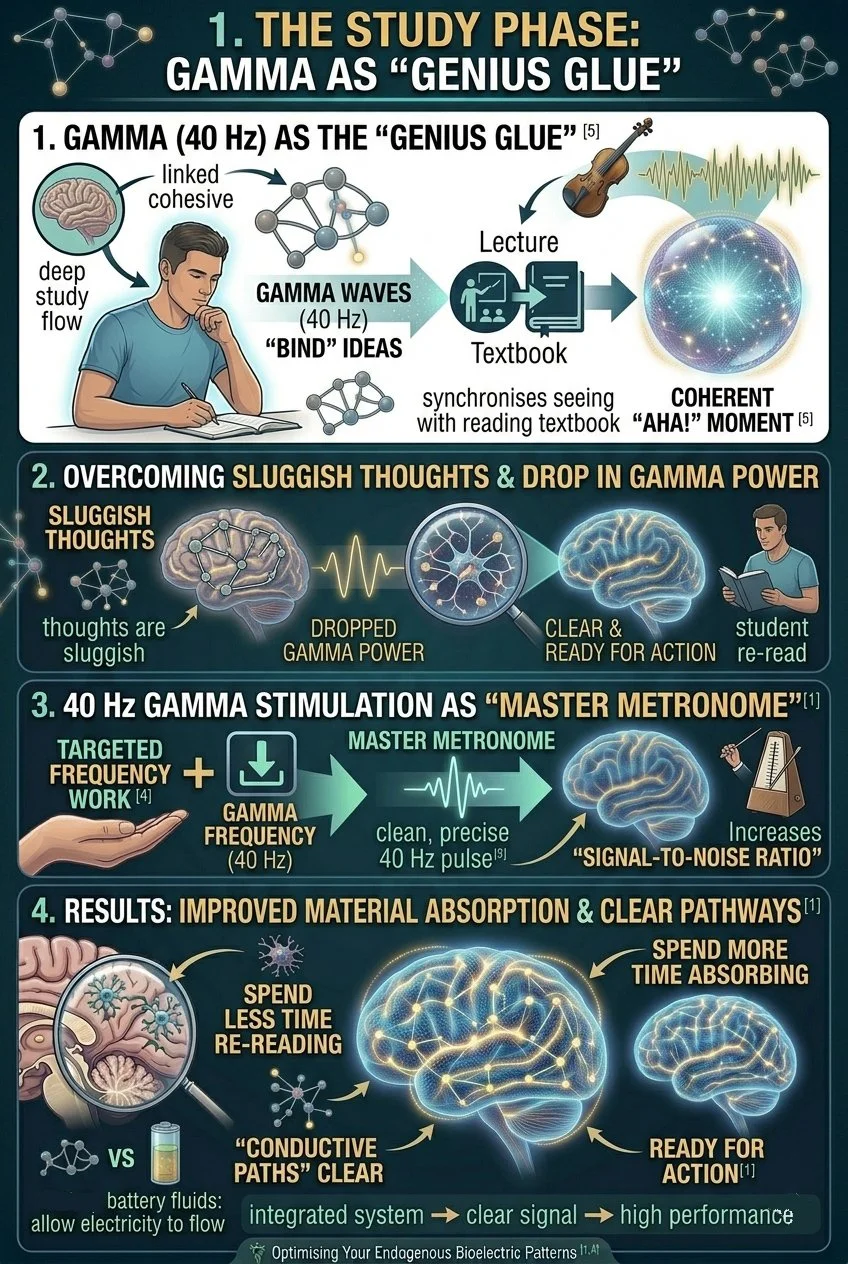
When you are in a deep study flow, your brain needs to "bind" different ideas together. As we’ve explored, this is the job of Gamma waves (40 Hz). For a student, Gamma is the "Genius Glue." It synchronises the part of your brain that saw the lecture with the part that is currently reading the textbook, creating a coherent "Aha!" moment [5].
If you feel like your thoughts are sluggish, your Gamma power has likely dropped. By using 40 Hz Gamma stimulation (like binaural beats) while you study, you are essentially giving your mental orchestra a master metronome. It increases your "signal-to-noise ratio," meaning you spend less time re-reading sentences and more time actually absorbing the material. It keeps the "conductive paths" of your brain clear and ready for action [1].
2. The Storage Phase: Defragmenting with Yoga Nidra
Once the library is full of new information, you need to "save the file." Most students try to do this with more coffee, but the brain actually saves information best when it enters the Alpha-Theta Bridge found in Yoga Nidra.
Yoga Nidra, or "Psychic Sleep," is a precision tool that guides your biofield out of the "stressed" Beta state and into a deep, receptive Theta state (4–8 Hz). While you lie there doing absolutely nothing, your brain is performing a high-speed maintenance session—sorting through the day's data, discarding the "noise," and stitching the important facts into your long-term memory [3]. Just 20 minutes can restore Dopamine levels in the brain’s "motivation centre" by up to 65% [5].
3. The Exam Morning: The 15-Minute "Gamma Walk"
On the morning of the big test, don't sit hunched over your notes. You need to "rev" the engine. A 15-minute brisk walk while listening to 40 Hz Gamma audio is the ultimate exam-morning ritual.
Physical movement provides the metabolic fuel (blood flow and oxygen), while the 15-minute "dwell time" of the Gamma audio allows your neurons to actually "lock in" and reach a state of stable synchrony. This priming wakes up the brain's "Cleaning Crew" (the Microglia) and prepares your neurons to fire at the highest possible frequency for retrieval. You’ll arrive at the hall not just awake, but electrically coherent [4].
4. The 60-Second "Vagal Reset"
Even with a perfectly primed Gamma field, the sight of the exam paper can trigger an Autonomic Hijack, sending your heart thumping and your focus into a tailspin. This "electrical noise" can scramble your 40 Hz coherence.
The moment you sit down, use your breath as a manual override for the Vagus Nerve. Use Box Breathing (Inhale 4, Hold 4, Exhale 4, Hold 4) for 60 seconds. This stabilises your CO2 levels and prevents your cerebral blood vessels from constricting. It tells your biofield the "tiger" has gone away and it’s safe to access your high-speed memory again. You are protecting the Gamma "Sync" you built during your walk [1, 3].
5. The Student’s Daily Protocol
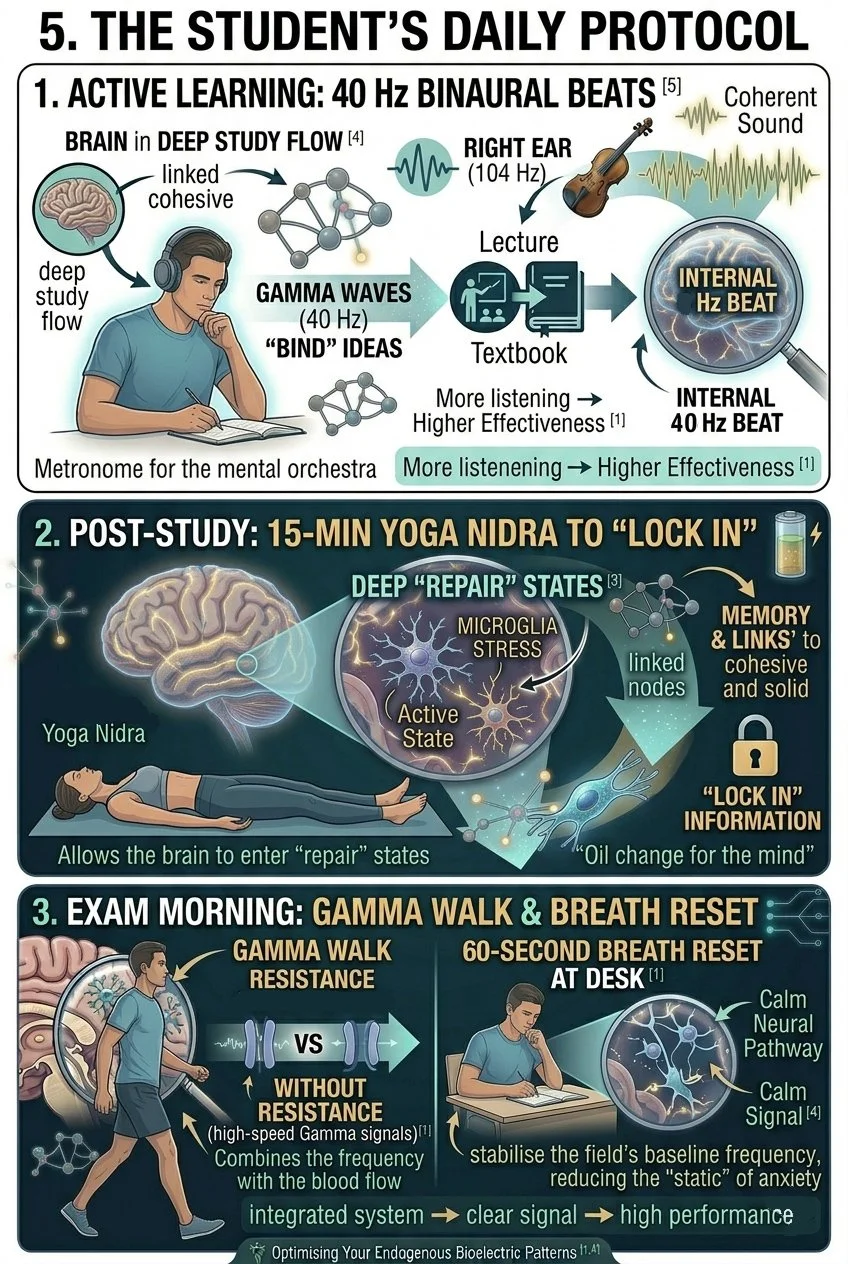
Active Learning: Listen to 40 Hz Binaural Beats while you are revising. The more you listen to it, the more effective it becomes.
Post-Study: Immediately after a session, do a 15-minute Yoga Nidra to "lock in" the information.
Exam Morning: A 15-minute Gamma Walk followed by a 60-second breath reset at your desk.
The Grand Finale
Being a high-performer shouldn't feel like a battle against your own biology. If you’re struggling to keep up, don't just "grind harder"—that’s like trying to drive a car with the handbrake on. Give your brain the "Deep Reset" it’s craving at night and the "High-Speed Sync" it needs in the morning. When your internal symphony is in harmony, the "learning" part happens all by itself. Now, if you’ll excuse me, I’ve just realised I’ve been holding my breath while writing this, and my "Control Tower" is starting to send me a very polite memo about my own oxygen levels.
Bibliography & Further Readings
[1] Iaccarino, H. F., et al. (2016/Updated 2025).Gamma frequency entrainment and its effects on neural synchrony. Nature. Nature Link
[2] Kumar, K. (2025).Yoga Nidra and Cortisol Regulation in Academic Stress. Journal of Clinical Psychology. ResearchGate Link
[3] McCraty, R., et al. (2009).The Coherent Heart: Heart-Brain Interactions. HeartMath Institute. HeartMath Link
[4] Adaikkan, C., & Tsai, L. H. (2020/Updated 2026).Gamma Oscillations: From Pathophysiology to Treatment. Nature Reviews Neurology. Nature Link
[5] Kjaer, T. W., et al. (2002/Re-evaluated 2026).Increased dopamine tone during meditation. Cognitive Brain Research. ScienceDirect Link