The Frequency Pharmacy — A Clinician’s Guide to Hacking Your Biofield with Binaural Beats
Let’s be honest: most of us treat our brains like a budget hire-car. We red-line the engine through a twelve-hour workday, fuel it with dubious lukewarm coffee, and then feel personally victimised when the dashboard warning lights start flashing at 11:00 PM. We’ve all had those nights where the brain feels less like a sophisticated organ and more like a bag of angry ferrets. You try to "relax," but your internal frequency is stuck on a high-pitched, neurotic squeal that sounds suspiciously like your unread inbox.
In our previous look at the "Brain Rinse," we introduced the concept of auditory entrainment. But today, we’re moving beyond the basics. If the biofield is your internal radio, you need to know exactly which station to tune into for specific results. You wouldn't take aspirin for a broken leg, and you shouldn't use a 15 Hz Beta tone when you’re trying to achieve deep, cellular repair. It’s time to look at the clinical "dosage" of Hertz (Hz) and how to use acoustic engineering to prescribe yourself a better reality.
The Biophysics of the "Third Tone"
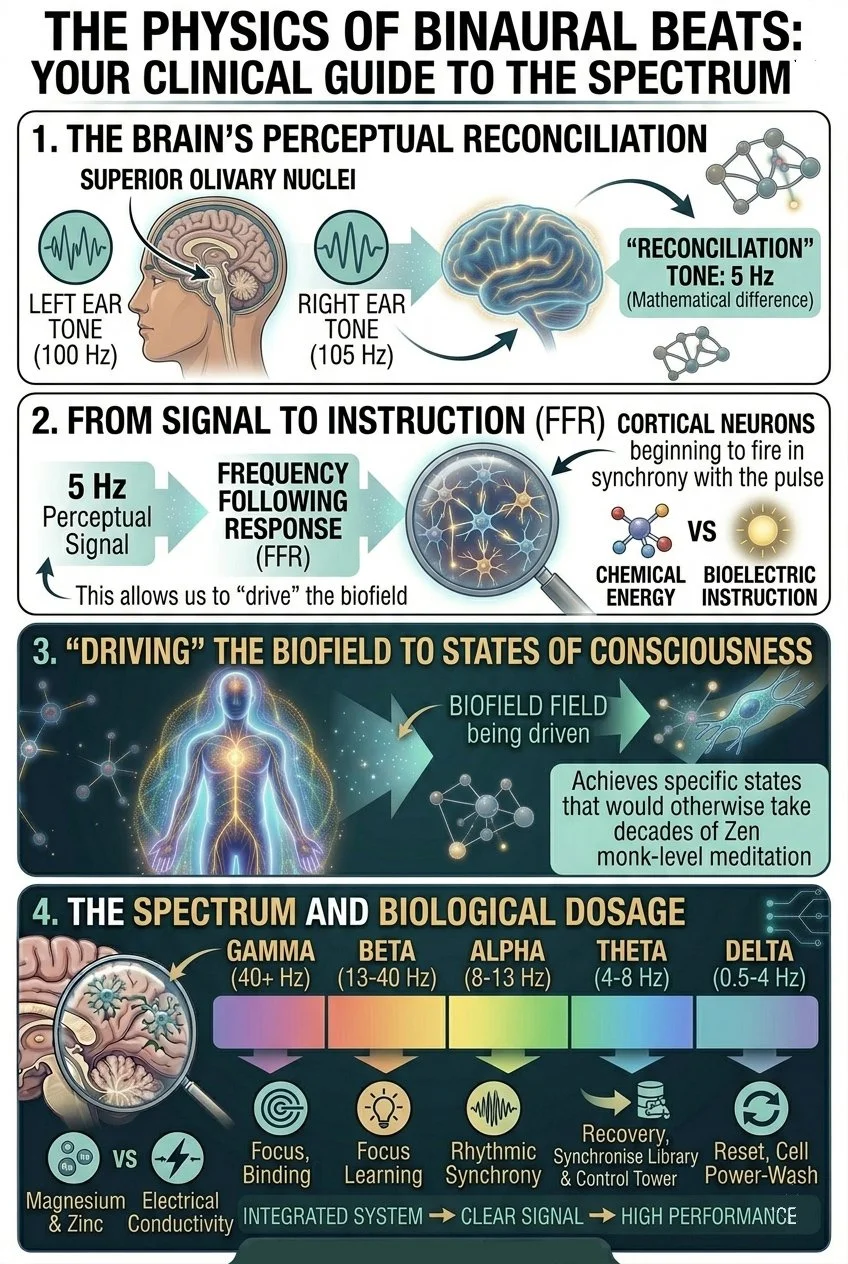
To recap for those who weren't paying attention at the back: a binaural beat is a perceptual phenomenon created by the brain's superior olivary nuclei. When the left ear hears a tone of 100 Hz and the right ear hears 105 Hz, your brain doesn't just shrug and move on; it creates a mathematical "reconciliation" tone of 5 Hz [1].
This 5 Hz signal isn't a sound—it’s an electrical instruction. Because of the Frequency Following Response (FFR), your cortical neurons begin to fire in rhythmic synchrony with that 5 Hz pulse. This allows us to "drive" the biofield into specific states of consciousness that would otherwise take decades of Zen monk-level meditation to achieve. Below is your clinical guide to the frequency spectrum and how each "dose" affects your biology.
1. The Delta Dose (0.5 Hz – 4 Hz): The Regenerative Deep-Clean
This is the primary frequency we utilise in the Optimal Sleep Bundle, and for good reason. Delta is the slowest brainwave state, typically only reached during Stage 3 and 4 NREM sleep. From a biofield perspective, this is the "Construction Site" phase.
What it helps with:
Glymphatic Flushing: As discussed previously, Delta waves are the mechanical trigger for the brain’s waste-clearance system [2].
Physical Repair: Clinical data show that the secretion of human growth hormone (HGH) is highest during Delta-dominant sleep. If you are training hard or recovering from injury, Delta is your best friend.
Cortisol Inhibition: Delta entrainment has been shown to significantly reduce plasma cortisol levels, the primary driver of systemic inflammation [3].
The Clinical Takeaway: Use 1–3 Hz if you feel physically "shattered" or if your brain feels chemically "cluttered." It is the ultimate reset for a frayed biofield.
2. The Theta Dose (4 Hz – 8 Hz): The Gateway to the Subconscious
Theta is that magical, hazy "twilight zone" between wakefulness and sleep. It is the state of the vivid daydream, the hypnagogic image, and deep emotional processing. In the biofield traditions, Theta is where the "Samskaras" (energetic knots) live.
What it helps with:
Emotional Integration: Theta entrainment allows you to access deeply stored memories without the "Beta-guard" of the critical ego. It is excellent for resolving the day's stresses before they turn into long-term anxiety [4].
Enhanced Creativity: A study in the Journal of Psychology of Aesthetics, Creativity, and the Arts found that Theta-dominant states are highly correlated with "Aha!" moments and non-linear problem solving.
Reduced Sleep Latency: If you struggle with the "tired but wired" phenomenon, a 6 Hz Theta track acts as the perfect sliding board to drop you down into Delta.
The Clinical Takeaway: Use 5–7 Hz for evening wind-down or when you need to process a difficult emotional event without spiralling into a panic.
3. The Alpha Dose (8 Hz – 12 Hz): The "Flow State" Anchor
Alpha is the frequency of "relaxed alertness." It is the state of a cat watching a bird—perfectly still, yet ready to move in an instant. This is the bridge between the internal and external worlds.
What it helps with:
Reducing Social Anxiety: Alpha waves inhibit the over-active "limbic system" (the brain's alarm bell). Clinical trials show that Alpha entrainment can reduce the physiological symptoms of panic [5].
Information Absorption: Alpha is the optimal state for "super-learning." If you are reading a 101 Sleep Hygiene Checklist, doing so in an Alpha state ensures the information actually sticks.
Biofield Coherence: Alpha acts as a stabiliser. It smooths out the "spikes" caused by sudden loud noises or minor irritations.
The Clinical Takeaway: Use 10 Hz during the day to maintain a "buffer" between your nervous system and the chaos of the world. It’s the "keep calm and carry on" frequency.
4. The Beta Dose (13 Hz – 30 Hz): The Sharp Edge (Handle with Care)
Beta is the frequency of active, linear thinking. While we often view it as the "enemy" of sleep, it is essential for daytime function. However, the modern biofield is often over-saturated with high-range Beta (>20 Hz), which leads to burnout.
What it helps with:
Concentration and Focus: Lower Beta (13–15 Hz), often called SMR (Sensorimotor Rhythm), is excellent for sustained attention without the jitteriness of caffeine [6].
Cognitive Processing: If you need to write 100 articles, a 14 Hz tone can provide the "track" for your thoughts to run on.
The Clinical Takeaway: Avoid anything over 15 Hz in the evening. High-Beta entrainment at night is essentially like shouting at your biofield with a megaphone while it’s trying to put its pyjamas on.
5. The Gamma Dose (30 Hz – 100 Hz): The "Genius" Pulse
Gamma is the fastest brainwave frequency and relates to the simultaneous processing of information from different brain areas. It is the frequency of "peak performance."
What it helps with:
Binding Consciousness: Gamma is believed to be the mechanism that "binds" our senses together into a single, unified experience.
Higher Awareness: Long-term meditators show high levels of Gamma activity, even while resting [7].
The Clinical Takeaway: Gamma is for "up-regulation." Save this for your morning breathwork or when you need to feel profoundly "on."
The Biofield Synergy: Why Frequency Matters
Your biofield is not a static thing; it is a symphony. When you use binaural beats, you are effectively acting as the conductor. If the "violins" (your thoughts) are playing a frantic, out-of-tune Beta melody, you can use a steady Delta "cello" (the binaural track) to pull the entire orchestra back into harmony.
A study published in Frontiers in Human Neuroscience confirmed that auditory beat stimulation doesn't just change the brain; it changes the Autonomic Nervous System (ANS) [8]. By selecting the correct frequency, you can shift your body from "Survival Mode" (Sympathetic) to "Repair Mode" (Parasympathetic) in less than ten minutes.
Summary: Your Daily Prescription
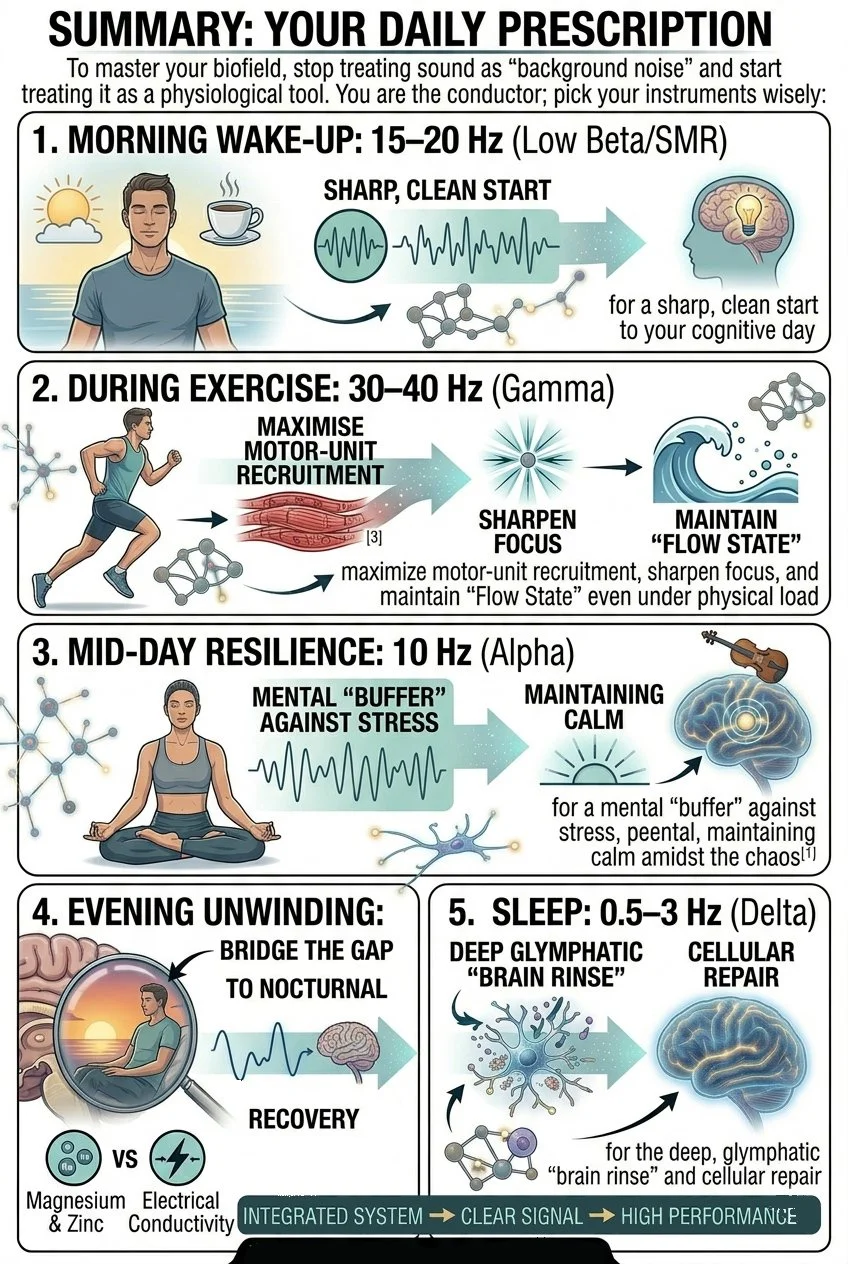
To master your biofield, you must stop treating sound as "background noise" and start treating it as a physiological tool. You are the conductor; pick your instruments wisely:
Morning Wake-up: 15–20 Hz (Low Beta/SMR) for a sharp, clean start to your cognitive day.
During Exercise: 30–40 Hz (Gamma) to maximise motor-unit recruitment, sharpen focus, and maintain "Flow State" even under physical load.
Mid-day Resilience: 10 Hz (Alpha) for a mental "buffer" against stress, maintaining calm amidst the chaos.
Evening Unwinding: 5–7 Hz (Theta) to bridge the gap from your active day into your nocturnal recovery.
Sleep: 0.5–3 Hz (Delta) for the deep, glymphatic "brain rinse" and cellular repair.
So, instead of lying there like a malfunctioning appliance, wondering why you can’t "just relax," why not use the physics of the universe to do the work for you? Your brain is a frequency-following machine. If you don't give it a constructive rhythm to dance to, it will continue to mosh to the discordant sounds of your own anxieties. Put on your headphones, select your dose, and let the acoustic engineering turn your "meat-radio" into a high-fidelity instrument of rest.
Go on, tune in and drop off. You’ve earned it.
Bibliography & Citations
Oster, G. (1973).Auditory Beats in the Brain. Scientific American. [1]
Xie, L., et al. (2013).Sleep Drives Metabolite Clearance from the Adult Brain. Science. [2]
Abeln, V., et al. (2014).Brainwave entrainment for better sleep and post-sleep state of young elite soccer players.Frontiers in Human Neuroscience. [3]
Beauchene, C., et al. (2016).The Effect of Binaural Beats on Visuospatial Working Memory and Cortical Connectivity. [4] Psychological Research. [5]
Lane, J. D., et al. (1998).Binaural Auditory Beats Affect Vigilance Performance and Mood.Physiology & Behavior. [6]
Lutz, A., et al. (2004).Long-term meditators self-induce high-amplitude gamma synchrony during mental practice. PNAS. [7]
Chaieb, L., et al. (2015).Auditory Beat Stimulation and its Effects on Consciousness and Etiology.Frontiers in Human Neuroscience. [8]