10 Clues Your Bioelectric Field is Out of Sync

If you’ve ever felt "off" despite your doctor telling you all your tests are normal, you aren't alone. We’ve all had those days where we feel scattered, heavy, or just physically "loud" inside, even when everything on the outside seems fine. It is that bizarre sensation where you are functioning perfectly well on paper, but internally you feel like a laptop with forty-seven tabs open, three of them are playing music you didn't choose, and you cannot find the mute button. You’re not "broken," you’re just buffering.
The truth is, you are more than just a collection of muscles and bones; you are an incredibly complex electrical system. You are essentially a walking, talking, slightly caffeinated biological battery. When that system gets a bit of "static" in the wires, your body starts sending you subtle signals to let you know it’s time for a recalibration. Think of yourself as a high-end smartphone: if the battery is bloated and the Wi-Fi signal is dropping, you don't throw the phone away; you look for the interference. In our modern, high-voltage world, we are finally beginning to address that interference by looking at the human Biofield.
The Science of the Human Biofield
The term "Biofield" was recognised by the US National Institutes of Health (NIH) as a legitimate area of study in 1992. Far from being a mystical concept, it refers to the endogenous, complex, dynamic electromagnetic field that regulates the human body [1].
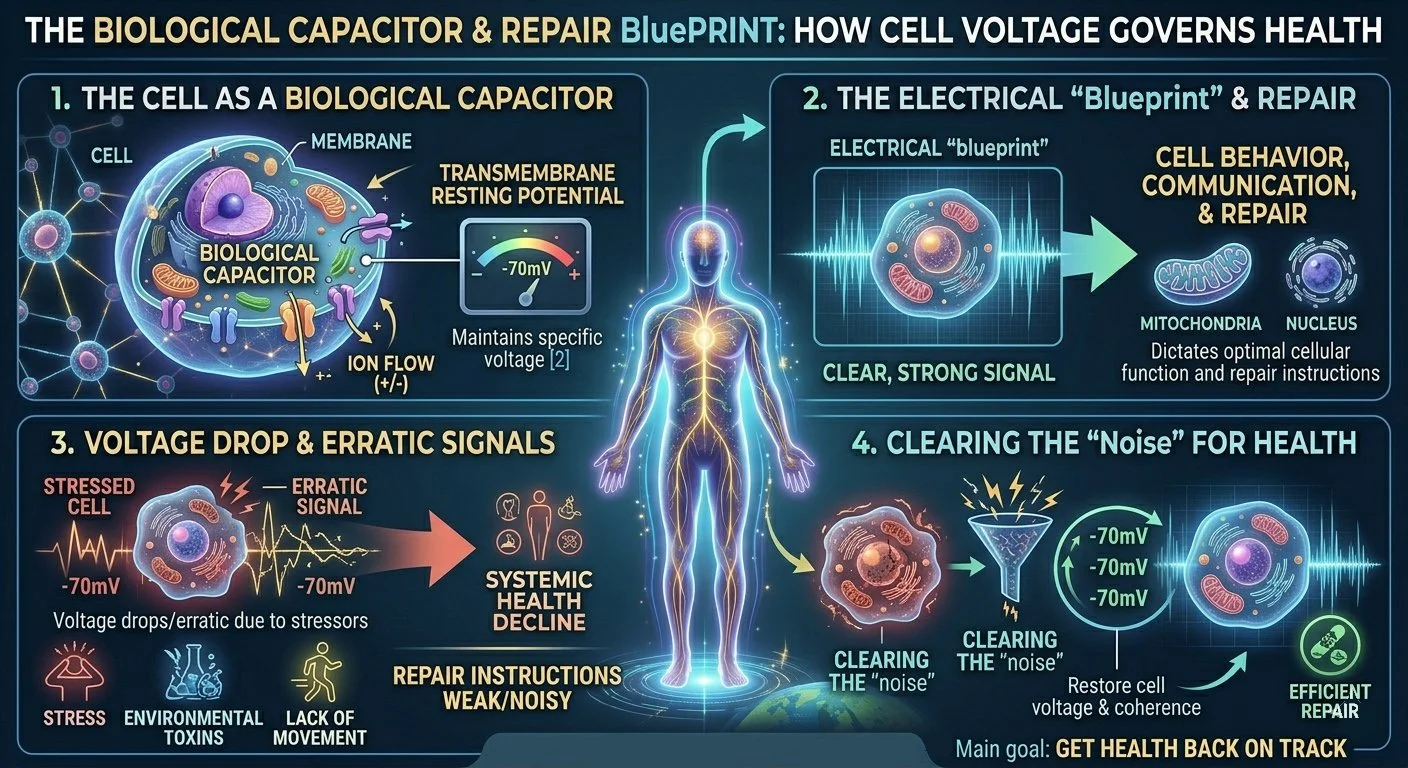
Every cell in your body acts as a biological capacitor, maintaining a specific voltage across its membrane, known as the “Transmembrane Resting Potential” [2]. This electrical "blueprint" is what dictates how your cells behave, communicate, and repair themselves. When this voltage drops or becomes erratic—often due to stress, environmental toxins, or lack of movement—your systemic health begins to decline. The "biological instructions" for repair are no longer carried out efficiently because the signal is too weak or too noisy. To get your health back on track, we have to clear the "noise."
10 Indicators of Bioelectric Incoherence
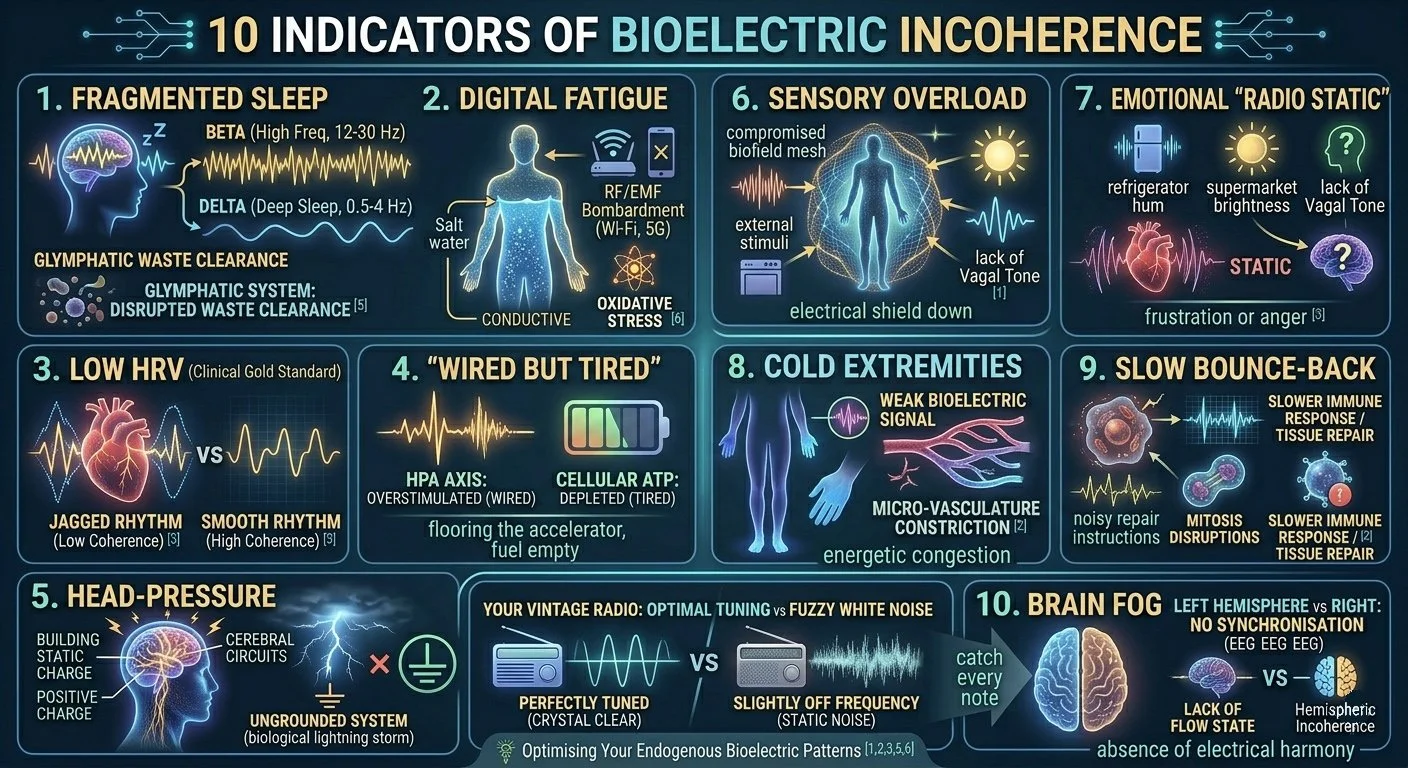
To understand how this affects you daily, we have to look at the "warning lights" on your biological dashboard. When your biofield is out of sync, it manifests in these ten very specific ways:
1. Fragmented Sleep and the "Delta" Deficit
The brain operates in specific frequency ranges. To achieve restorative sleep, you must transition from high-frequency Beta waves (12–30 Hz), which are great for spreadsheets but terrible for rest, to low-frequency Delta waves (0.5–4 Hz). Research suggests that disrupted electromagnetic rhythms in the brain prevent the glymphatic system—the brain's waste clearance mechanism—from functioning properly [5]. Without that "Delta" deep-dive, your brain literally cannot "take out the trash," leaving you feeling emotionally and mentally cluttered the next morning.
2. Digital Fatigue and EMF Sensitivity
Because humans are highly conductive (we are mostly salt water, after all), we are susceptible to "coupling" with external electromagnetic fields. A study suggests that non-ionising radiation, such as the Wi-Fi signals and cellular data surrounding us 24/7, can trigger oxidative stress in the cells [6]. If your biofield is thin or lacks cohesion, you experience "Digital Fatigue" more acutely than others—that feeling of being physically drained just by sitting in a room full of computers.
3. Low Heart Rate Variability (HRV)
HRV is the clinical gold standard for measuring autonomic nervous system health. The heart’s electromagnetic field is the most powerful in the body, detectable several feet away. Research into Global Coherence has demonstrated that low HRV is a direct indicator that this field is no longer "coherent" and is struggling to adapt to environmental stressors [3]. When your heart rhythm becomes "jagged," your entire system loses its rhythmic anchor.
4. The "Wired but Tired" Paradox
This occurs when your HPA axis (Hypothalamic-Pituitary-Adrenal) is overstimulated. Your nervous system is firing at a high frequency (wired), but your cellular ATP production—the energy currency of the cell—is depleted (tired). This mismatch is a classic sign of a "short circuit" in your stress-response system. You are effectively flooring the accelerator while the fuel tank is empty, leading to a profound sense of systemic burnout.
5. Persistent "Head-Pressure" (Congested Charge)
In biophysics, this is often a result of an "ungrounded" system. When the body is not physically in contact with a conductive surface (like the Earth), it can build up a positive static charge. This often manifests as pressure in the temples or forehead, indicating an accumulation of charge in the cerebral circuits. It is the biological equivalent of a lightning storm that has no way to strike the ground, so it just sits in your head, making everything feel heavy.
6. Sensory Overload
A healthy biofield acts as a biological filter. When the field's "cohesion" is compromised, the nervous system becomes hyper-reactive to external stimuli—a condition often linked to a lack of Vagal Tone [1]. If the hum of the refrigerator or the brightness of a supermarket feels physically aggressive, your "electrical shield" is likely down, leaving your nerves exposed to the raw data of the world.
7. Emotional "Radio Static"
The heart’s field carries information. Research shows that emotional states like frustration or anger create "disordered or jagged electromagnetic patterns" in the heart, which the brain then interprets as anxiety [3]. You aren't necessarily "anxious" in the psychological sense; your heart is simply broadcasting "static," and your brain is trying its best to make sense of the noise.
8. Chronic Cold Extremities
Blood flow follows bioelectric signalling. If the "signal strength" to the peripheral nerves is weak or restricted by a "survival mode" loop, the micro-vasculature constricts [2]. This is common in a system that is energetically "congested" in the core, leaving the hands and feet struggling to maintain their thermal equilibrium.
9. Slow Biological "Bounce-Back"
Cells rely on specific electrical signals for Mitosis (cell division). Disrupted fields result in "noisy" signals, slowing down the body's natural tissue repair and immune response cycles [2]. If every minor bruise or cold seems to take weeks to resolve, your body’s "repair crew" might be struggling to hear the instructions over the internal interference.
10. Brain Fog (Hemispheric Incoherence)
This is a lack of synchronisation between the left and right hemispheres of the brain. Electroencephalogram (EEG) studies show that when a person is in "flow," their brainwaves are perfectly synchronised. Brain fog is the literal absence of this electrical harmony. It’s like trying to run a race where your left leg and right leg are operating in different time zones—you’re moving, but it’s far more difficult than it should be.
Think of your body like a vintage radio. Sometimes you're perfectly tuned to the station, and everything is crystal clear—the music is great, the signal is strong, and you’re catching every note. Other times, you’re just slightly off the frequency, and all you get is that annoying, fuzzy white noise that makes you want to tap the side of your head until the music comes back.
You aren't "broken," and you certainly aren't crazy—you’re just currently stuck between stations, listening to the energetic equivalent of a blender running in the next room. You wouldn't expect a radio to play a clear tune if its antenna was bent into a pretzel, so don't expect your body to feel "zen" when its wires are crossed by the static of modern life. Remember that even the most sophisticated systems need a little fine-tuning now and then. So, before you decide that you’re permanently "wired wrong," remember that even a Ferrari needs a tune-up to keep its engine humming. Let's get you back to the clear signal, shall we? You’ve got a much better soundtrack waiting to be played.
Bibliography & Further Readings
[1] Rubik, B. (2002). The Biofield Hypothesis: Its Biophysical Basis and Role in Medicine. Journal of Alternative and Complementary Medicine. PubMed Link
[2] Levin, M. (2012). Molecular bioelectricity in development, regeneration and cancer. Nature Reviews Cancer. Nature Link
[3] McCraty, R., et al. (2009). The Global Coherence Initiative: Creating a Coherent Maternal Field. Global Advances in Health and Medicine. HeartMath Research Link
[4] Baconnier, S., et al. (2002). Calcite microcrystals in the pineal gland of the human brain. Bioelectromagnetics. Wiley Online Library Link
[5] Jessen, N. A., et al. (2015). The Glymphatic System: A Beginner’s Guide. Neurochemical Research. NCBI Link
[6] Yakymenko, I., et al. (2016). Oxidative mechanisms of biological activity of low-intensity radiofrequency radiation. Electromagnetic Biology and Medicine. Taylor & Francis Link